AI Benchmark 2026: What It Is and Why Demand Grew 84%
Every frontier model launch now ships with a wall of benchmark numbers. They are the only common currency we have for comparing AI systems, yet most of the named tests behind those numbers change faster than the models they measure. This guide explains what an AI benchmark is, the major categories and named tests in use, how capability is measured in 2026, why old benchmarks keep saturating, and where speed and efficiency fit. Where a figure is sourced from internal keyword research rather than a published study, it is labeled as such.
What is an AI benchmark?
An AI benchmark is a standardized test that measures how well an AI system performs a defined task using a fixed dataset, a scoring metric, and a repeatable protocol. It turns vague claims like “state of the art” into comparable numbers. Without a shared test, every vendor’s “best model” claim is unfalsifiable marketing (Source: IBM, 2025).
The concept predates large language models. ImageNet standardized computer vision in 2012, and GLUE standardized natural language understanding in 2018 (Source: Stanford HAI, 2025). What unites all of them is structure: a benchmark bundles sample data, a task definition, an evaluation metric, and a scoring rule so that different systems can be ranked on equal footing.
How does an AI benchmark work?
A benchmark works by running a system through a fixed set of tasks, capturing its outputs, and grading them with an automated or human-judged metric. Grading is either objective, comparing answers against ground truth, or preference-based, where humans pick the better of two responses. Scores roll up into a single percentage or rating.
The grading method shapes what a score means. Multiple-choice tests like MMLU check whether the chosen letter matches an answer key, which scales cheaply across thousands of questions (Source: arXiv, 2020). Coding benchmarks execute generated code against unit tests, a far stricter pass-or-fail signal (Source: arXiv, 2023). The metric is not a detail; it determines whether a high score is meaningful.
Why did searches for “ai benchmark” grow 84%?
Search demand for the term “ai benchmark” rose roughly 84% year over year, based on TokenDyno’s internal keyword research using DataForSEO trend data. This is a search-demand signal, not a published market study, and it tracks a real shift: as models multiply, buyers and engineers increasingly need a neutral way to compare them.
The interest mirrors what the field measures. Stanford’s AI Index documented that systems went from solving 4.4% of SWE-bench coding problems in 2023 to 71.7% in 2024, with double-digit gains on multimodal and science benchmarks in a single year (Source: Stanford HAI, 2025). When capability moves that fast, the tests that measure it become a topic in their own right.
What are the major categories of AI benchmarks?
AI benchmarks split into roughly five families: knowledge and reasoning, coding and agentic, multimodal perception, human preference, and systems or speed. No single test captures general capability, so labs report a mix (Source: Evidently AI, 2025). The category determines how a score is graded and what it actually predicts about real use.
Treating all benchmarks as interchangeable is the most common mistake. A knowledge benchmark and a latency benchmark answer completely different questions, and a model can dominate one while failing another. The sections below define each family by its grading approach and what a strong score tells you.
Knowledge and reasoning benchmarks
Knowledge and reasoning benchmarks test whether a model recalls facts and works through multi-step problems across many subjects. They are usually multiple-choice and graded against an answer key, which makes them cheap to run at scale. Examples include MMLU, MMLU-Pro, GPQA Diamond, and BIG-bench (Source: arXiv, 2020; Source: arXiv, 2024).
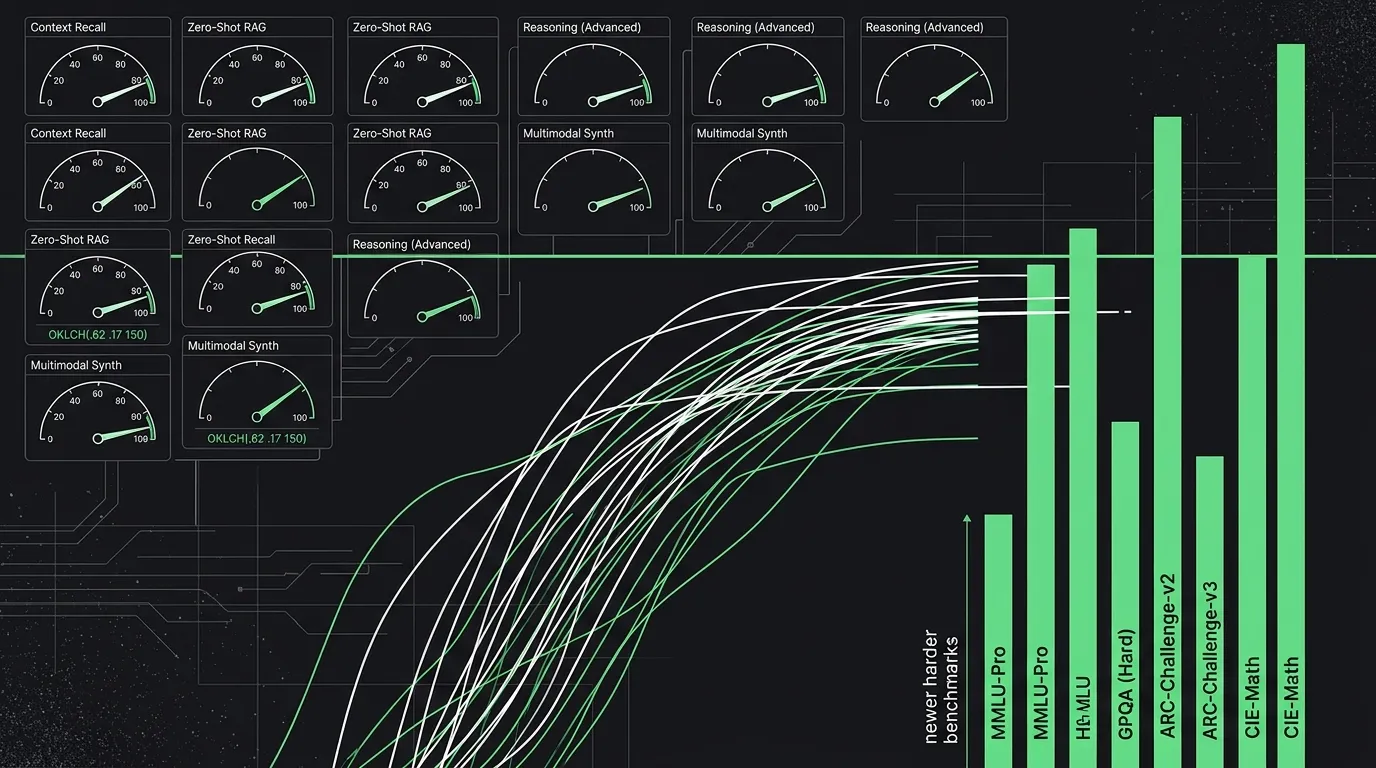
These dominate headline comparisons, but the easiest ones are now saturated. Frontier models cluster between 92% and 94% on the original MMLU, leaving almost no room to differentiate them (Source: arXiv, 2024). That ceiling is exactly why harder successors such as GPQA Diamond and Humanity’s Last Exam were created, a shift covered later in this guide.
Coding and agentic benchmarks
Coding benchmarks measure whether a model produces correct, runnable code, graded by executing unit tests rather than matching text. The category ranges from short function-writing tasks like HumanEval to full GitHub-issue resolution in real repositories, as in SWE-bench Verified (Source: arXiv, 2021; Source: arXiv, 2023).
Agentic benchmarks extend this to tool use, planning, and multi-step task completion, scoring whether a system can call APIs and chain actions correctly. HumanEval’s 164 problems are now largely saturated above 90%, so attention has moved to SWE-bench Verified, a 500-task human-validated subset where models patch actual open-source bugs (Source: arXiv, 2023; Source: Epoch AI, 2026). As of June 2026, the leaders sit around 91% on that test.
Multimodal and perception benchmarks
Multimodal benchmarks evaluate reasoning across images, audio, diagrams, and video alongside text. The leading example is MMMU, which combines text, images, tables, and diagrams across more than 30 disciplines to test cross-modal reasoning (Source: arXiv, 2024). Historic vision benchmarks like ImageNet defined this space before being saturated.
The same saturation pattern is repeating here. MMMU-Pro was built to eliminate guessing shortcuts, and model scores drop substantially against it, falling to roughly 17% to 27% across tested systems compared with the original MMMU (Source: arXiv, 2024). Multimodal evaluation is younger than text evaluation, so its hardest tests still separate the top models.
Human-preference and systems benchmarks
Human-preference benchmarks skip ground truth entirely. LMArena shows anonymous model outputs side by side, collects a vote, and converts millions of votes into a Bradley-Terry rating. It is the closest public proxy for which model feels better to use, with more than 6.8 million votes aggregated as of mid-2026 (Source: LMArena, 2026).
Systems benchmarks measure the machine, not the model. MLPerf standardizes hardware and inference performance, while speed benchmarks track tokens per second and latency. These answer a different question from capability tests: not whether a system can solve a task, but how fast and cheaply it does so (Source: Artificial Analysis, 2026).
Which AI benchmarks matter most in 2026?
The most-cited AI benchmarks in 2026 span six domains, and they age at very different rates. The table below groups the major named tests by domain and marks whether each is saturated, meaning frontier models cluster near the ceiling, or still active, meaning it continues to separate the leaders.
| Benchmark | Domain | Status | Source |
|---|---|---|---|
| MMLU | Knowledge / reasoning | Saturated (~92–94%) | (Source: arXiv, 2020) |
| MMLU-Pro | Knowledge / reasoning | Active | (Source: arXiv, 2024) |
| GPQA Diamond | PhD-level science Q&A | Active | (Source: arXiv, 2023) |
| HellaSwag | Commonsense language | Saturated | (Source: arXiv, 2019) |
| GLUE / SuperGLUE | NLP understanding | Saturated (retired) | (Source: Stanford HAI, 2025) |
| GSM8K | Grade-school math | Saturated | (Source: arXiv, 2021) |
| MATH | Competition math | Saturated | (Source: arXiv, 2021) |
| HumanEval | Code generation | Saturated (>90%) | (Source: arXiv, 2021) |
| SWE-bench Verified | Real-world software engineering | Active | (Source: Epoch AI, 2026) |
| MMMU / MMMU-Pro | Multimodal reasoning | Active | (Source: arXiv, 2024) |
| ImageNet | Computer vision | Saturated (retired) | (Source: Stanford HAI, 2025) |
| LMArena | Human preference | Active | (Source: LMArena, 2026) |
| ARC-AGI-2 | Abstract reasoning | Active | (Source: ARC Prize, 2025) |
| Humanity’s Last Exam | Frontier expert knowledge | Active | (Source: Nature, 2026) |
| FrontierMath | Research-level math | Active | (Source: Epoch AI, 2026) |
| MLPerf | Hardware / inference systems | Active | (Source: Stanford HAI, 2025) |
The pattern is consistent: yesterday’s headline benchmark becomes today’s saturated baseline. MMLU, GSM8K, HumanEval, HellaSwag, ImageNet, and SuperGLUE are all retired as differentiators, while the active tests are deliberately harder successors built in 2024 and 2025.
Why are AI benchmarks becoming saturated?
AI benchmarks saturate when frontier models all score near the ceiling, so the test can no longer distinguish them and small gaps fall within statistical noise. Saturation has accelerated because capability is improving faster than new tests can be authored. Stanford’s AI Index lists MMLU, GSM8K, and HumanEval among the benchmarks that topped out, prompting a migration to harder ones (Source: Stanford HAI, 2025).
The cascade is fast. GLUE was saturated by BERT-class models within roughly a year of its 2018 release, and the same arc later played out for SuperGLUE, MMLU, and the original MMMU (Source: Stanford HAI, 2025). For anyone comparing models, the lesson is to weight benchmarks that still have headroom over saturated classics where every system looks identical.
What does benchmark saturation look like?
Saturation looks like a leaderboard where the top ten models sit within two or three percentage points of each other and of a human baseline. At that point the benchmark measures noise, not capability. On the original MMLU, frontier models now cluster in the low-to-mid 90s, so rank order is partly statistical chance (Source: arXiv, 2024).
The fix is a harder test, not a better metric. MMLU-Pro added more answer options and reasoning-heavy questions, cutting accuracy by double digits and spreading the field back out (Source: arXiv, 2024). MMMU-Pro did the same for multimodal models. Each successor buys the field a year or two before frontier systems close the gap again.
How does data contamination accelerate saturation?
Data contamination occurs when benchmark questions leak into a model’s training data, inflating scores because the model recalls answers instead of reasoning. It accelerates apparent saturation: a contaminated benchmark looks solved before models are genuinely capable, which forces labs to retire it early (Source: arXiv, 2025).
The defensive response is contamination-resistant design. FrontierMath uses unpublished problems, and tests like LiveCodeBench draw on fresh, post-cutoff tasks so memorization cannot help (Source: Epoch AI, 2026). This is also why many teams now run private, task-specific evaluations alongside public benchmarks, since a private test set cannot be contaminated by definition.
What are the hardest AI benchmarks in 2026?
The hardest AI benchmarks in 2026 are ARC-AGI-2, Humanity’s Last Exam, and FrontierMath, each built specifically because older tests broke. They share a design goal: deliberately resist memorization and saturation so they still separate the top handful of models. On all three, frontier systems score well below the human or expert ceiling (Source: ARC Prize, 2025; Source: Nature, 2026).
These tests now anchor model announcements. When a lab wants to demonstrate genuine progress, a saturated benchmark proves nothing, so the frontier reasoning tests below have become the reference points that matter.
How hard are ARC-AGI-2 and ARC-AGI-3?
ARC-AGI-2 tests abstract reasoning through visual grid puzzles that humans solve easily but models struggle to generalize. Launched in March 2025, every frontier model scored near 0% at release; by early 2026 the strongest reasoning models had climbed to the mid-70s, while humans still solve essentially all tasks (Source: ARC Prize, 2025).
The frontier has already moved on. The ARC Prize Foundation launched ARC-AGI-3, an agentic successor, in 2026, and in its developer preview humans solved 100% of environments while the best language models scored below 1% (Source: ARC Prize, 2025). The gap illustrates how far machine reasoning still lags human generalization on novel problems.
How hard are Humanity’s Last Exam and FrontierMath?
Humanity’s Last Exam (HLE) is a 2,500-question expert benchmark spanning more than 100 subjects, written by nearly 1,000 specialists across 50 countries and published in Nature in 2026 (Source: Nature, 2026). It was built explicitly to counter MMLU saturation. As of mid-2026, the top reported score was about 53% in the no-tools setting, far below the near-90s on older knowledge tests.
FrontierMath targets research-level mathematics with unpublished problems graded for correctness, and Epoch AI released a corrected v2 in June 2026 (Source: Epoch AI, 2026). Both tests report scores in strict and tool-enabled settings, and independently run results often differ from labs’ self-reported numbers, so the measurement context matters as much as the headline figure.
Where do speed and efficiency benchmarks fit?
Speed benchmarks measure how fast a system serves output, not how smart it is. The core metrics are output speed in tokens per second, time to first token, and end-to-end latency. They determine whether an application feels instant or sluggish, and they vary enormously across hardware and provider even for an identical model (Source: Artificial Analysis, 2026).
Most capability leaderboards ignore this dimension, yet it drives real-world cost and user experience. A model that wins on accuracy can still lose in production if it generates text too slowly to feel responsive. Independent trackers measure live tokens-per-second across providers for exactly this reason, and the spread is large: the same model can run more than 30 times faster on specialized hardware than on a slow provider (Source: Artificial Analysis, 2026).
Why do speed and capability scores complement each other?
Speed and capability answer different questions, so a serious evaluation needs both. A capability score tells you whether a model can solve a task; a speed benchmark tells you whether it can do so fast and cheaply enough to ship. Optimizing one in isolation produces either a brilliant-but-slow assistant or a fast-but-wrong one.
The practical workflow is to shortlist models on capability benchmarks, then filter that shortlist on measured tokens per second and latency under expected load. For the broader methodology, see AI Benchmarking and What Is an LLM Benchmark?; for current standings across models, see the LLM Leaderboard 2026.
Frequently asked questions
What is an AI benchmark?
An AI benchmark is a standardized test that scores how well an AI system performs a defined task, such as reasoning, coding, or image understanding. It combines a fixed dataset, a task definition, an evaluation metric, and a scoring rule so different systems can be compared fairly on equal footing (Source: IBM, 2025).
What are the hardest AI benchmarks in 2026?
The hardest AI benchmarks in 2026 are ARC-AGI-2 for abstract reasoning, Humanity’s Last Exam for expert knowledge, and FrontierMath for research mathematics. All three were built to resist saturation, and frontier models score far below human or expert ceilings, with top HLE results near 53% (Source: Nature, 2026; Source: ARC Prize, 2025).
Why are AI benchmarks becoming saturated?
AI benchmarks saturate when frontier models all cluster near the maximum score, erasing meaningful differences. Capability is improving faster than new tests can be authored, and data contamination inflates scores further. MMLU, GSM8K, HumanEval, ImageNet, and SuperGLUE are all saturated, which pushed the field toward harder successors (Source: Stanford HAI, 2025).
How is AI capability measured in 2026?
AI capability is measured with a portfolio of benchmarks rather than one test: knowledge and reasoning, coding and agentic, multimodal, human preference, and systems speed. No single benchmark captures general capability, so labs report a mix and weight unsaturated tests that still separate the leaders (Source: Evidently AI, 2025).
Do AI benchmarks measure speed?
Most capability benchmarks do not. Speed is measured separately by systems benchmarks such as MLPerf and by throughput trackers that report tokens per second, time to first token, and latency. These metrics vary widely by provider and hardware for the same model, so speed should be evaluated alongside capability (Source: Artificial Analysis, 2026).
What is the difference between a benchmark and a leaderboard?
A benchmark is a single standardized test with its own dataset and scoring method. A leaderboard aggregates results from one or many benchmarks to rank systems. One leaderboard can report many benchmark scores at once, so a model’s rank depends on which benchmarks that leaderboard includes (Source: LMArena, 2026).
Key takeaways
An AI benchmark is a standardized, repeatable test that scores a defined capability, built from a dataset, a task, a metric, and a scoring rule. The major families span knowledge, coding and agentic, multimodal, human preference, and systems speed, and no single test captures general capability. Rising search interest, up roughly 84% year over year in our internal keyword research, tracks a real acceleration documented by Stanford’s AI Index.
Treat scores as evidence, not verdicts. Saturation and contamination inflate or flatten results, which is why the hardest 2026 tests, ARC-AGI-2, Humanity’s Last Exam, and FrontierMath, exist at all. The strongest evaluations pair fresh public benchmarks with private, task-specific tests and measured speed before anything ships.
Sources
- IBM, “What Are LLM Benchmarks?” (2025): https://www.ibm.com/think/topics/llm-benchmarks
- Stanford HAI, 2025 AI Index Report, Technical Performance (2025): https://hai.stanford.edu/ai-index/2025-ai-index-report/technical-performance
- Evidently AI, “LLM benchmarks and evaluation” (2025): https://www.evidentlyai.com/llm-guide/llm-benchmarks
- Hendrycks et al., MMLU, arXiv:2009.03300 (2020): https://arxiv.org/abs/2009.03300
- TIGER-AI-Lab, MMLU-Pro, arXiv:2406.01574 (2024): https://arxiv.org/abs/2406.01574
- Rein et al., GPQA, arXiv:2311.12022 (2023): https://arxiv.org/abs/2311.12022
- Zellers et al., HellaSwag, arXiv:1905.07830 (2019): https://arxiv.org/abs/1905.07830
- Cobbe et al., GSM8K, arXiv:2110.14168 (2021): https://arxiv.org/abs/2110.14168
- Hendrycks et al., MATH, arXiv:2103.03874 (2021): https://arxiv.org/abs/2103.03874
- Chen et al., HumanEval, arXiv:2107.03374 (2021): https://arxiv.org/abs/2107.03374
- Jimenez et al., SWE-bench, arXiv:2310.06770 (2023): https://arxiv.org/abs/2310.06770
- Epoch AI, SWE-bench Verified and FrontierMath benchmarks (2026): https://epoch.ai/benchmarks
- Yue et al., MMMU, arXiv:2311.16502 (2024): https://arxiv.org/abs/2311.16502
- ARC Prize, ARC-AGI-2 and ARC-AGI-3 results (2025): https://arcprize.org/blog/arc-prize-2025-results-analysis
- Phan et al., Humanity’s Last Exam, Nature (2026): https://www.nature.com/articles/s41586-025-09962-4
- Epoch AI, Humanity’s Last Exam tracking (2026): https://epoch.ai/benchmarks/hle
- LMArena, human-preference leaderboard (2026): https://lmarena.ai/
- Artificial Analysis, model speed and efficiency benchmarks (2026): https://artificialanalysis.ai/
- Internal keyword research via DataForSEO, search-demand trend for “ai benchmark” (2026)