AI Benchmarking: Methodologies, Datasets, and the Speed Layer
A benchmark number is only as trustworthy as the method behind it. A reported “71% on SWE-bench” or “1450 Elo on the arena” is the output of a long pipeline: a dataset is built, a prompting protocol is fixed, outputs are graded, scores are aggregated, contamination is checked, and the whole run is made reproducible. This guide opens that pipeline stage by stage, then covers the emerging speed layer that measures throughput and latency rather than capability. It is the methodology companion to our overview of AI Benchmark 2026, which covers what benchmarks are and why they saturate; here we cover exactly how they work.
How does AI benchmarking actually work?
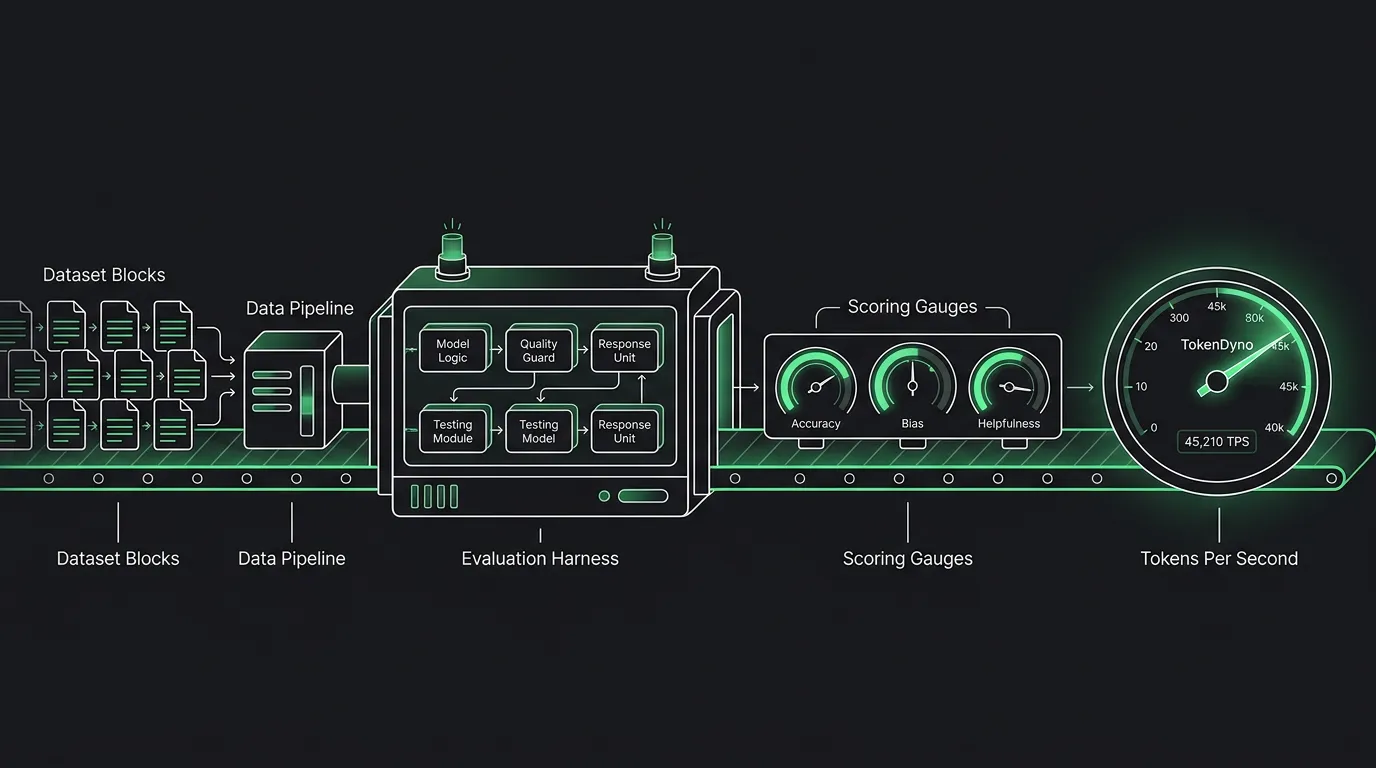
AI benchmarking runs a model through a fixed pipeline: a dataset defines the tasks, an evaluation protocol fixes how the model is prompted, a grader scores each output, and an aggregation rule rolls scores into one number. Stanford’s HELM formalized this as scenarios paired with metrics, evaluating 30 models across 42 scenarios (Source: Liang et al., arXiv, 2022) https://arxiv.org/abs/2211.09110.
Every stage is a design decision that changes the result. The same model can score very differently depending on how many examples it sees, whether it is allowed to reason step by step, and whether grading is exact-match or preference-based. This is why two leaderboards reporting “MMLU” can disagree: they share a dataset but differ in protocol.
The sections below walk the pipeline in order. The throughline is that a benchmark score is not a measurement of a model in isolation; it is a measurement of a model under a fully specified procedure, and the procedure is the part most reports omit.
How are benchmark datasets constructed?
A benchmark dataset bundles three things: input samples, a task definition, and ground-truth answers or a reference. Datasets are built by sourcing items (exams, GitHub issues, competition problems), filtering for quality, and validating answers. SWE-bench Verified, for example, is a 500-task human-validated subset of real GitHub issues, screened so each task is actually solvable (Source: OpenAI, 2024) https://openai.com/index/introducing-swe-bench-verified/.
What makes a benchmark dataset reliable?
Reliability comes from three properties: correct labels, adequate size, and difficulty headroom. Labels must be verifiable, which is why coding benchmarks favor executable unit tests over human judgment, and math benchmarks favor problems with a single checkable answer. HumanEval pioneered this with 164 hand-written programming problems graded by running tests (Source: Chen et al., arXiv, 2021) https://arxiv.org/abs/2107.03374.
Size matters because small test sets produce wide error bars. A 200-item benchmark cannot distinguish a model scoring 88% from one scoring 90%, because the gap sits inside the sampling noise. Headroom matters because once frontier models cluster near the ceiling, the dataset stops separating them. The hardest 2026 benchmarks are deliberately authored to keep that headroom open.
How do held-out and dynamic datasets reduce leakage?
A static public dataset has a structural weakness: once it is online, it can be scraped into the next model’s training corpus, making memorization indistinguishable from skill. Two designs fight this. Held-out private sets keep answers (and sometimes questions) unpublished, as FrontierMath does with unpublished research-level problems (Source: Epoch AI, 2025) https://epoch.ai/frontiermath.
Dynamic benchmarks go further by adding fresh items over time. LiveCodeBench collects new competitive-programming problems continuously from LeetCode, AtCoder, and Codeforces; its v6 release covers 1,055 problems published between May 2023 and April 2025, and it grows every month (Source: Jain et al., ICLR / arXiv, 2024) https://arxiv.org/abs/2403.07974. Because problems carry release dates, evaluators can score a model only on problems published after its training cutoff.
What evaluation protocols do benchmarks use?
The evaluation protocol specifies how the model is prompted before any answer is graded. The main axes are shot count (zero-shot vs few-shot), whether step-by-step reasoning is elicited, and whether grading is automated or judge-based. HELM standardized on 5-shot prompting to keep comparisons fair across models (Source: Liang et al., arXiv, 2022) https://arxiv.org/abs/2211.09110. Protocol choices routinely move scores by more than the gaps between models.
What are zero-shot, few-shot, and chain-of-thought protocols?
Zero-shot gives the model only the task; few-shot prepends worked examples inside the prompt. The distinction was formalized in the GPT-3 paper, which showed large models improve sharply as in-context examples are added (Source: Brown et al., arXiv, 2020) https://arxiv.org/abs/2005.14165. Reporting a few-shot score next to a zero-shot score without saying which is not a fair comparison.
Chain-of-thought (CoT) prompting asks the model to show intermediate reasoning before the final answer, and it substantially raises accuracy on multi-step math and logic tasks (Source: Wei et al., arXiv, 2022) https://arxiv.org/abs/2201.11903. Because CoT changes the score so much, modern benchmarks state the exact setting: 0-shot CoT, 8-shot CoT, or no-tools. A headline number without its protocol label is not reproducible.
What is LLM-as-a-judge, and where does it break?
LLM-as-a-judge uses a strong model to grade open-ended outputs that have no single correct answer, scoring or ranking responses the way a human rater would. It was introduced and validated against human preferences in the MT-Bench and Chatbot Arena work, which reported that a strong judge agrees with humans at roughly the rate humans agree with each other (Source: Zheng et al., arXiv, 2023) https://arxiv.org/abs/2306.05685.
The method has documented failure modes. A systematic study found position bias that can push judges to favor the first-presented answer up to 75% of the time, alongside verbosity bias and self-enhancement bias, where a judge prefers its own family’s outputs by an estimated 10-25% (Source: Shi et al., arXiv, 2024) https://arxiv.org/abs/2406.07791.
Mitigations are now standard practice. Evaluators swap answer positions and average both orders, anchor scoring to a reference answer, and use a judge from a different provider than the model under test. These do not eliminate bias, but they make judge scores defensible enough to publish.
How are benchmark scores computed and aggregated?
Scoring converts raw outputs into one comparable number, and the rule depends on the task. Multiple-choice tests use exact-match accuracy; coding tests use pass@k, the probability that at least one of k sampled solutions passes all unit tests, formalized in the HumanEval paper (Source: Chen et al., arXiv, 2021) https://arxiv.org/abs/2107.03374. Preference benchmarks skip ground truth and fit a statistical rating instead.
How does pass@k and exact-match scoring work?
Exact-match accuracy is the simplest rule: parse the model’s chosen letter or final answer, compare it to the answer key, and report the fraction correct. It is cheap and reproducible, which is why knowledge benchmarks scale to thousands of questions. Its weakness is brittleness around formatting, which is why robust harnesses normalize answers before matching.
Pass@k is stricter because code either runs or it does not. Reporting pass@1 measures single-shot reliability, while pass@10 measures whether the model can solve a problem given several attempts. The two numbers answer different questions, so a benchmark must state which k it reports. Aggregation across subtasks is usually a simple or weighted mean, and the weighting is itself a methodological choice.
How are preference and Elo-style scores aggregated?
Human-preference platforms aggregate pairwise votes into a single rating using the Bradley-Terry model, the statistical method behind the Chatbot Arena leaderboard (Source: Chiang et al., arXiv, 2024) https://arxiv.org/abs/2403.04132. Each battle is a pairwise comparison; millions of votes are fit into ratings with bootstrapped confidence intervals so that uncertainty is visible alongside rank.
The confidence interval is the part that matters and the part most readers skip. When the top models’ intervals overlap, the rank order between them is partly statistical noise, and they should be read as tied. In 2025 LMArena documented corrections for two newly observed biases in its Bradley-Terry fit: a position bias favoring the left-hand model, and an advantage for models sharing an organization with prior context (Source: LMArena, 2025) https://news.lmarena.ai/leaderboard-changelog/. Independent work has shown that dropping a handful of votes can reorder the top of the board (Source: Singh et al., arXiv, 2025) https://arxiv.org/abs/2504.20879.
How do benchmarks control contamination and overfitting?
Contamination control prevents test items from leaking into training data, where memorization would inflate scores. The two lines of defense are detection and prevention. Detection methods estimate whether specific items appeared in pretraining; prevention uses canary strings, held-out answers, and temporal cutoffs. Most teams now treat prevention as the reliable path, because detection alone has had limited success (Source: Jain et al., arXiv, 2024) https://arxiv.org/abs/2403.07974.
How do canary strings and decontamination work?
A canary string is a unique GUID embedded in a benchmark so that, if it later appears in a model’s outputs or training logs, contamination is exposed. BIG-bench popularized this with a fixed canary identifier (Source: Srivastava et al., arXiv, 2022) https://arxiv.org/abs/2206.04615. The method has real limits: a careless trainer can strip the canary, and detection requires access to model log-probabilities, which closed APIs do not expose.
Temporal decontamination is more robust. If a benchmark records each item’s publication date, an evaluator scores a model only on items released after its training cutoff, so memorization is impossible by construction. LiveCodeBench applies exactly this, which is why it reports growing problem counts over versioned releases rather than a fixed set (Source: Jain et al., arXiv, 2024) https://arxiv.org/abs/2403.07974.
How is overfitting to a benchmark detected?
Overfitting shows up as a gap between public-benchmark performance and performance on a fresh, equivalent test. A model tuned hard against MMLU may post a strong public number yet drop sharply on a held-out variant covering the same skills. LiveBench was built around this principle, releasing new questions monthly so that scores reflect generalization rather than fit to a frozen set (Source: White et al., arXiv, 2024) https://arxiv.org/abs/2406.19314.
The practical defense is to never rank on a single public benchmark. Serious evaluation pairs public tests with a private, task-specific holdout that no model could have trained on, and treats a large public-minus-private gap as a contamination or overfitting warning rather than a capability claim. For a fuller treatment of what gets measured, see What Is LLM Benchmarking?.
How is AI benchmarking made reproducible?
Reproducibility means another team can rerun the evaluation and get the same number, which requires versioned code, fixed prompts, and pinned decoding settings. Three standards anchor this: EleutherAI’s lm-evaluation-harness for language tasks, Stanford’s HELM for holistic capability, and MLCommons’ MLPerf for systems performance. The harness alone covers 60+ benchmarks and backs the Open LLM Leaderboard (Source: EleutherAI, 2024) https://github.com/EleutherAI/lm-evaluation-harness.
Which tools and standards make benchmarks reproducible?
The lm-evaluation-harness is the de facto standard for open-weight evaluation: it fixes prompts, decoding, and metrics, and reports bootstrapped standard errors so uncertainty is explicit (Source: Biderman et al., arXiv, 2024) https://arxiv.org/abs/2405.14782. HELM adds breadth, scoring models across many scenarios on seven dimensions including accuracy, calibration, robustness, and efficiency, all under one standardized interface (Source: Liang et al., arXiv, 2022) https://arxiv.org/abs/2211.09110.
MLPerf governs the systems side. Its Inference v5.1 round (September 2025) standardized latency-bounded throughput, specifying time-to-first-token and time-per-output-token limits per scenario, with Llama 2 70B as the most-submitted workload across 24 submitters (Source: MLCommons, 2025) https://mlcommons.org/2025/09/mlperf-inference-v5-1-results/.
The table below maps each pipeline stage to its method, the tool or standard that implements it, and a source.
| Stage | Method | Tool / Standard | Source |
|---|---|---|---|
| Dataset construction | Curate, validate, hold out or grow over time | SWE-bench Verified, FrontierMath, LiveCodeBench | (Source: Jain et al., arXiv, 2024) https://arxiv.org/abs/2403.07974 |
| Prompting protocol | Zero/few-shot, chain-of-thought | lm-evaluation-harness, HELM (5-shot) | (Source: Liang et al., arXiv, 2022) https://arxiv.org/abs/2211.09110 |
| Grading | Exact-match, pass@k, LLM-as-a-judge | HumanEval, MT-Bench | (Source: Chen et al., arXiv, 2021) https://arxiv.org/abs/2107.03374 |
| Aggregation | Mean accuracy, Bradley-Terry rating | Chatbot Arena / LMArena | (Source: Chiang et al., arXiv, 2024) https://arxiv.org/abs/2403.04132 |
| Contamination control | Canary strings, temporal cutoffs | BIG-bench, LiveCodeBench | (Source: Srivastava et al., arXiv, 2022) https://arxiv.org/abs/2206.04615 |
| Reproducibility | Versioned code, pinned settings | lm-evaluation-harness | (Source: Biderman et al., arXiv, 2024) https://arxiv.org/abs/2405.14782 |
| Systems / speed | Latency-bounded throughput | MLPerf Inference | (Source: MLCommons, 2025) https://mlcommons.org/2025/09/mlperf-inference-v5-1-results/ |
What is the speed layer in AI benchmarking?
The speed layer benchmarks how fast and cheaply a model serves output, not how smart it is. Its core metrics are time-to-first-token (TTFT), output speed in tokens per second, and end-to-end latency. Artificial Analysis defines TTFT as the seconds between sending a request and receiving the first token, and runs throughput tests eight times daily across 1k, 10k, and 100k input workloads (Source: Artificial Analysis, 2025) https://artificialanalysis.ai/methodology/performance-benchmarking.
Why do throughput and latency need a separate methodology?
Speed is a property of a deployment, not just a model. The identical model weights produce very different tokens-per-second depending on hardware, quantization, batch size, and provider. In MLPerf Inference v5.1, a single submission of FP8-quantized Llama 3.1-8B on one H100 GPU reached 5,777 tokens/sec offline and 5,103 tokens/sec in the server scenario, while the same model on an L40S delivered a fraction of that (Source: MLCommons, 2025) https://mlcommons.org/2025/09/mlperf-inference-v5-1-results/.
That variance is why capability benchmarks cannot also measure speed. Throughput must be measured under a fixed input size, concurrency level, and latency bound, or the number is meaningless. MLPerf enforces this by pairing every throughput figure with TTFT and TPOT constraints, so a fast number is only valid if it also met the interactivity limit.
How do speed and capability scores fit together?
Speed and capability answer different questions, so a complete evaluation needs both. A capability score tells you whether a model can solve the task; a speed benchmark tells you whether it can do so fast and cheaply enough to ship. Optimizing one alone yields either a brilliant-but-sluggish assistant or a fast-but-wrong one, and production systems fail on both.
The practical workflow is two-stage: shortlist models on capability benchmarks, then filter that shortlist on measured tokens-per-second and latency under your expected load. TokenDyno tracks the live speed layer across models and providers, and current capability standings live in the LLM Leaderboard 2026.
Frequently asked questions
How does AI benchmarking work?
AI benchmarking runs a model through a fixed pipeline: a dataset defines tasks, a protocol fixes prompting (zero-shot, few-shot, or chain-of-thought), a grader scores outputs by exact-match, pass@k, or judge, and an aggregation rule produces one number. Standards like HELM and lm-evaluation-harness pin these steps for reproducibility (Source: Liang et al., arXiv, 2022) https://arxiv.org/abs/2211.09110.
What is LLM-as-a-judge?
LLM-as-a-judge uses a strong model to grade open-ended outputs that lack a single correct answer, scoring or ranking responses like a human rater. Validated against human preferences in MT-Bench, it suffers position, verbosity, and self-enhancement biases, so evaluators swap positions and use cross-provider judges (Source: Zheng et al., arXiv, 2023) https://arxiv.org/abs/2306.05685.
How do you prevent benchmark contamination?
Contamination is prevented with three methods: held-out private answer keys, canary strings that expose leakage, and temporal cutoffs that score a model only on items published after its training date. Dynamic benchmarks like LiveCodeBench add fresh problems monthly, making memorization impossible by construction (Source: Jain et al., arXiv, 2024) https://arxiv.org/abs/2403.07974.
What is MLPerf?
MLPerf is the MLCommons benchmark suite that standardizes machine-learning systems performance, including LLM inference. Its Inference v5.1 round (September 2025) measures latency-bounded throughput with fixed time-to-first-token and time-per-output-token limits per scenario, letting hardware be compared on equal, reproducible footing (Source: MLCommons, 2025) https://mlcommons.org/2025/09/mlperf-inference-v5-1-results/.
What is the difference between zero-shot and few-shot evaluation?
Zero-shot gives the model only the task description; few-shot prepends worked examples inside the prompt. The GPT-3 paper showed large models gain accuracy as in-context examples are added, so comparing a few-shot score to a zero-shot score without labeling them is not a fair comparison (Source: Brown et al., arXiv, 2020) https://arxiv.org/abs/2005.14165.
Why do benchmark scores differ across leaderboards?
Two leaderboards reporting the same benchmark can disagree because they differ in protocol: shot count, chain-of-thought, decoding temperature, answer normalization, and tool access all move scores more than the gaps between models. Reproducibility requires pinning every setting, which is why versioned harnesses exist (Source: Biderman et al., arXiv, 2024) https://arxiv.org/abs/2405.14782.
Key takeaways
A benchmark number is the output of a fully specified procedure, not a property of a model. Dataset construction sets the ceiling, the prompting protocol sets the conditions, the grader sets what counts as correct, and aggregation sets how uncertainty is shown. Change any stage and the number changes, often by more than the gap between the models being compared.
The mature practice is to read methodology before rank. Confirm the protocol label, check whether the dataset is contamination-resistant, read the confidence interval before the position, and pair public scores with a private holdout. Then add the speed layer: a model that wins on capability can still lose in production if it serves tokens too slowly. For the broader landscape, see AI Benchmark 2026.
Sources
- Liang et al., HELM: Holistic Evaluation of Language Models, arXiv:2211.09110 (2022): https://arxiv.org/abs/2211.09110
- EleutherAI, lm-evaluation-harness (2024): https://github.com/EleutherAI/lm-evaluation-harness
- Biderman et al., Lessons from the Trenches on Reproducible Evaluation, arXiv:2405.14782 (2024): https://arxiv.org/abs/2405.14782
- MLCommons, MLPerf Inference v5.1 Results (2025): https://mlcommons.org/2025/09/mlperf-inference-v5-1-results/
- Chen et al., HumanEval / Evaluating LLMs Trained on Code, arXiv:2107.03374 (2021): https://arxiv.org/abs/2107.03374
- OpenAI, Introducing SWE-bench Verified (2024): https://openai.com/index/introducing-swe-bench-verified/
- Jain et al., LiveCodeBench, arXiv:2403.07974 (2024): https://arxiv.org/abs/2403.07974
- Epoch AI, FrontierMath (2025): https://epoch.ai/frontiermath
- Brown et al., Language Models are Few-Shot Learners (GPT-3), arXiv:2005.14165 (2020): https://arxiv.org/abs/2005.14165
- Wei et al., Chain-of-Thought Prompting, arXiv:2201.11903 (2022): https://arxiv.org/abs/2201.11903
- Zheng et al., Judging LLM-as-a-Judge with MT-Bench and Chatbot Arena, arXiv:2306.05685 (2023): https://arxiv.org/abs/2306.05685
- Shi et al., Judging the Judges: Position Bias in LLM-as-a-Judge, arXiv:2406.07791 (2024): https://arxiv.org/abs/2406.07791
- Chiang et al., Chatbot Arena, arXiv:2403.04132 (2024): https://arxiv.org/abs/2403.04132
- LMArena, Leaderboard Changelog (2025): https://news.lmarena.ai/leaderboard-changelog/
- Singh et al., The Leaderboard Illusion, arXiv:2504.20879 (2025): https://arxiv.org/abs/2504.20879
- Srivastava et al., BIG-bench, arXiv:2206.04615 (2022): https://arxiv.org/abs/2206.04615
- White et al., LiveBench, arXiv:2406.19314 (2024): https://arxiv.org/abs/2406.19314
- Artificial Analysis, Performance Benchmarking Methodology (2025): https://artificialanalysis.ai/methodology/performance-benchmarking