LLM Benchmark: A Complete Guide to Model Evaluation
An LLM benchmark is a standardized test that measures how well a large language model performs a defined task, so models can be compared on the same scale instead of through vendor claims. This guide defines the term, maps the full taxonomy of benchmark categories, explains how evaluation actually works, names the leading benchmarks in each category with their sources, and covers the limitations that make a high score less trustworthy than it looks. It closes with how to choose a benchmark for your use case and why inference speed belongs in any honest evaluation.
What is an LLM benchmark?
An LLM benchmark is a fixed dataset of tasks paired with a scoring method that produces a comparable number for any model that takes the test. The original MMLU benchmark, for example, scores models on 15,908 multiple-choice questions across 57 subjects against an expert human baseline of about 89.8% (Source: Hendrycks et al., 2020). The score, not the model’s marketing, is the unit of comparison.
What does a benchmark actually contain?
Every LLM benchmark has three parts: a dataset of inputs, a set of reference answers or a grading rubric, and a scoring metric that turns model outputs into a number. MMLU pairs 14,079 test questions with labeled correct options and scores by accuracy (Source: Hendrycks et al., 2020). SWE-bench pairs 2,294 real GitHub issues with hidden unit tests and scores by whether the model’s code patch makes those tests pass (Source: Jimenez et al., 2023). The three parts together make results reproducible and provider-independent.
How is a benchmark different from a leaderboard?
A benchmark is one test; a leaderboard is the ranking that results when many models take one or more tests. MMLU and SWE-bench are benchmarks. LMArena and Artificial Analysis are leaderboards that aggregate results. A model’s leaderboard position depends entirely on which benchmarks feed it and how each is weighted, so the two terms are not interchangeable. For the ranking side, see LLM Leaderboard 2026; for a deeper definition, see What Is an LLM Benchmark?.
Why do LLM benchmarks matter?
Benchmarks matter because they are the only repeatable, public way to compare models before committing budget and engineering time. With frontier models shipping monthly, no buyer can test every option in depth. A benchmark compresses thousands of evaluations into a single comparable figure. The catch is that a score predicts your results only when the test measures tasks like yours, on a clean dataset, in a field that has not yet saturated near the ceiling.
How does LLM benchmarking work?
LLM benchmarking works by running a model over a fixed dataset under controlled conditions, then scoring its outputs with one of three methods: exact-match grading against reference answers, programmatic verification such as unit tests, or judgment by humans or another model. The grading method matters as much as the questions, because it determines what counts as correct and how reproducible the result is.
What are the main scoring methods?
There are three dominant scoring methods. Exact-match grades multiple-choice or short-answer responses against a labeled key, as MMLU and GPQA do (Source: Rein et al., 2023). Programmatic verification runs code or checks rules, as SWE-bench’s unit tests and IFEval’s 25 verifiable instruction types do (Source: Zhou et al., 2023). Human or LLM-as-judge grading scores open-ended quality, as MT-Bench’s GPT-4 judge does (Source: Zheng et al., 2023). Each trades objectivity against the ability to grade open-ended work.
Why does the grading method change the result?
The grading method can swing scores more than the model does. LiveBench adopted fully automated, ground-truth scoring after finding that LLM-judge grading of hard reasoning and math problems had an error rate as high as 46% (Source: White et al., 2025). Exact-match scoring is reproducible but cannot grade nuanced writing. LLM-judge scoring grades open-ended work but introduces position bias and self-preference. Before trusting a number, confirm how it was graded, not just what was asked.
What is pass@k and why is it used?
Pass@k measures the probability that at least one of k sampled attempts is correct, and it is the standard metric for code benchmarks where a model can try more than once. HumanEval introduced it across 164 Python problems; the original Codex model scored 28.8% pass@1, meaning under a third of single attempts were correct (Source: Chen et al., 2021). Pass@1 reflects single-shot reliability; higher k rewards models that can solve a problem given multiple tries, which matters for agentic retry loops.
What are the main types of LLM benchmarks?
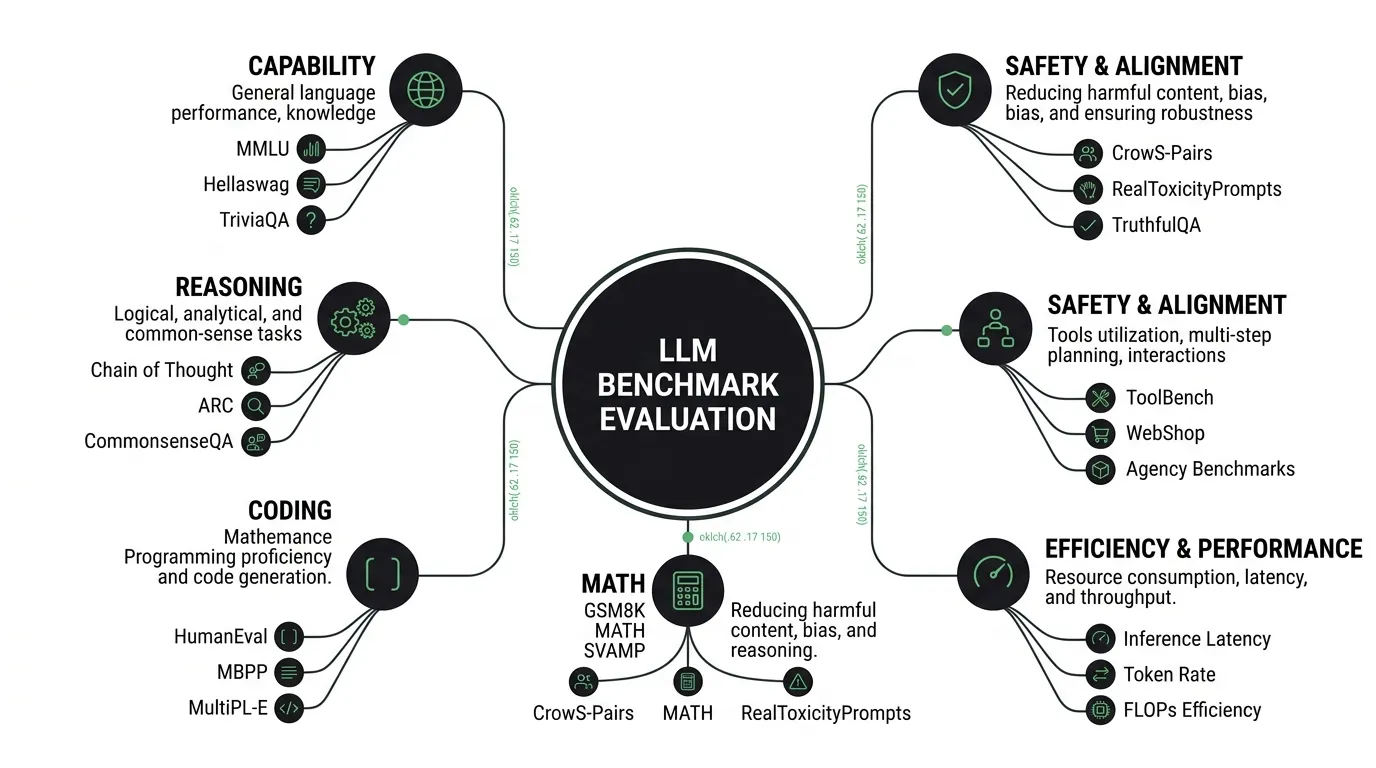
The main types of LLM benchmarks fall into seven categories: general capability, reasoning, coding, math, agentic and tool use, safety and truthfulness, and efficiency or speed. Each answers a different question, so a model that leads one category routinely trails in another. The taxonomy table below maps each category to its leading named benchmarks, what they measure, and their source.
| Category | Example benchmarks | What it measures | Source |
|---|---|---|---|
| General capability | MMLU, MMLU-Pro, GPQA Diamond, Humanity’s Last Exam | Broad multi-subject knowledge and graduate-level Q&A accuracy | Hendrycks et al., 2020; Wang et al., 2024; Rein et al., 2023; Phan et al., 2025 |
| Reasoning | ARC-AGI-2, GPQA, BIG-Bench Hard | Abstract, fluid, and multi-step reasoning that resists memorization | Chollet et al., 2025; Rein et al., 2023; Suzgun et al., 2022 |
| Coding | SWE-bench Verified, HumanEval, LiveCodeBench, Aider Polyglot, Terminal-Bench | Real bug fixing, function completion, and multi-language editing | Jimenez et al., 2023; Chen et al., 2021; Jain et al., 2024; Aider, 2024 |
| Math | AIME 2025, MATH, FrontierMath, GSM8K | Competition and research-level mathematical problem solving | Hendrycks et al., 2021; Epoch AI, 2024; Cobbe et al., 2021 |
| Agentic / tool use | GAIA, tau2-bench, WebArena, Terminal-Bench | Multi-step tool use, web browsing, and policy-adherent task completion | Mialon et al., 2023; Sierra, 2024; Zhou et al., 2023 |
| Safety / truthfulness | TruthfulQA, AILuminate, HELM Safety, HarmBench | Truthfulness, harm avoidance, and jailbreak robustness | Lin et al., 2021; MLCommons, 2025; Mazeika et al., 2024 |
| Efficiency / speed | Artificial Analysis, MLPerf Inference | Output tokens/sec, time to first token, latency, and throughput | Artificial Analysis, 2026; MLCommons, 2025 |
For a longer category-by-category walkthrough, see LLM Benchmarks: The Full 2026 Landscape and Examples of LLM Benchmarks.
What are general capability benchmarks?
General capability benchmarks test broad knowledge across many subjects. MMLU spans 57 subjects but is now saturated, with frontier models clustered above 88% since mid-2024 (Source: Hendrycks et al., 2020). MMLU-Pro raised difficulty to 10 answer options across roughly 12,000 questions to de-saturate it (Source: Wang et al., 2024). GPQA Diamond uses 198 expert-written, “Google-proof” science questions where skilled non-experts score about 34% even with web access (Source: Rein et al., 2023). These measure recall and applied knowledge, not autonomy.
What are reasoning benchmarks?
Reasoning benchmarks isolate fluid problem solving from memorized knowledge. ARC-AGI-2, created by François Chollet’s ARC Prize, uses abstract grid puzzles that are easy for humans but resist memorization; models scored under 5% at its May 2025 launch (Source: Chollet et al., 2025). Humanity’s Last Exam, built by the Center for AI Safety and Scale AI with about 1,000 experts, contains 2,500 questions across 100-plus subjects explicitly designed to fight saturation (Source: Phan et al., 2025). BIG-Bench Hard selects 23 tasks where models historically underperformed humans (Source: Suzgun et al., 2022).
What are coding benchmarks?
Coding benchmarks measure whether a model can write or fix working software. SWE-bench presents 2,294 real GitHub issues graded by the repository’s own unit tests; its 500-task Verified subset was built with OpenAI’s Preparedness team (Source: OpenAI, 2024). LiveCodeBench date-stamps competitive-programming problems so models are tested only on problems published after their training cutoff, limiting contamination (Source: Jain et al., 2024). Aider Polyglot grades 225 hard Exercism exercises across six languages, and Terminal-Bench tests agentic DevOps tasks in containerized shells (Source: Aider, 2024). For depth, see LLM Coding Benchmark.
What are math benchmarks?
Math benchmarks range from saturated grade-school sets to unsolved research problems. GSM8K’s 8,500 grade-school word problems are now above 95% for frontier models and considered too easy (Source: Cobbe et al., 2021). The MATH dataset’s 12,500 competition problems are largely saturated (Source: Hendrycks et al., 2021). AIME, the actual olympiad-track exam, is used because new contests post-date training cutoffs. FrontierMath, built by Epoch AI, contains hundreds of original, unpublished, “guessproof” problems; models scored under 2% at its late-2024 launch (Source: Epoch AI, 2024). Live FrontierMath standings: https://epoch.ai/benchmarks/frontiermath-tiers-1-3-v2 (accessed 2026-06-28).
What are agentic and tool-use benchmarks?
Agentic benchmarks test whether a model can plan, call tools, and complete multi-step tasks rather than answer a single prompt. GAIA poses 466 real-world questions needing reasoning, browsing, and tool use, where early GPT-4 with plugins scored about 15% against a human 92% (Source: Mialon et al., 2023). tau2-bench, from Sierra, simulates a user and grades policy-adherent tool calls against a realistic database (Source: Sierra, 2024). WebArena, from CMU, runs agents in self-hosted web app clones where the best GPT-4 agent originally scored 14.4% versus humans at 78.2% (Source: Zhou et al., 2023).
What are safety and truthfulness benchmarks?
Safety benchmarks measure harm avoidance, truthfulness, and robustness to attack. TruthfulQA’s 817 questions target imitative falsehoods and human misconceptions (Source: Lin et al., 2021). AILuminate, from MLCommons, grades models on 24,000 human-generated prompts across hazard categories using a tuned ensemble of evaluators, with grades set relative to a reference model (Source: MLCommons, 2025). HarmBench measures refusal robustness against automated jailbreak attacks such as GCG and PAIR (Source: Mazeika et al., 2024). Crucially, AILuminate is negative-predictive: passing does not certify a model as safe (Source: MLCommons, 2025).
What are instruction-following and preference benchmarks?
Instruction and preference benchmarks measure how well a model follows directions and how much humans like its output. IFEval checks roughly 500 prompts against 25 programmatically verifiable instruction types such as length and format, with no LLM judge (Source: Zhou et al., 2023). LMArena (formerly Chatbot Arena), originating from UC Berkeley’s Sky Computing Lab, converts blind pairwise human votes into a Bradley-Terry rating across millions of votes (Source: Chiang et al., 2024). Arena-Hard mines 500 challenging real queries from Arena data for automated judging (Source: Li et al., 2024).
What are efficiency and speed benchmarks?
Efficiency benchmarks measure how fast and cheaply a model serves output, a dimension capability tests ignore. Artificial Analysis measures output tokens per second, time to first token, and end-to-end latency against live API endpoints on a rolling cadence (Source: Artificial Analysis, 2026). MLPerf Inference, from MLCommons, measures hardware throughput and latency under standardized scenarios; its v5.1 release in September 2025 set a participation record of 27 submitters and added a reasoning workload (Source: MLCommons, 2025). These determine whether an application feels instant or sluggish.
What are the limitations of LLM benchmarks?
The main limitations of LLM benchmarks are data contamination, saturation, weak construct validity, and outright gaming. One survey reported contamination rates up to 91.8% across popular multilingual benchmarks (Source: Survey on Data Contamination in LLMs, 2025). Each limitation makes a high score a weaker predictor of real-world performance than it appears, which is why no single number should decide a deployment.
How does data contamination distort scores?
Contamination happens when benchmark questions leak into training data, so a model recalls answers instead of reasoning. It is measurable and large: Scale AI reported that a model resolving roughly 81% of SWE-bench Verified tasks resolved only about 46% on its contamination-resistant SWE-bench Pro under standardized scaffolding (Source: Scale AI, 2026). In early 2026 OpenAI publicly stopped evaluating on SWE-bench Verified, citing contamination and flawed tests (Source: OpenAI, 2026). Paraphrase and translation can hide contamination from simple n-gram detectors (Source: Survey on Data Contamination in LLMs, 2025).
Why does benchmark saturation matter?
Saturation occurs when frontier models all cluster near a benchmark’s ceiling, at which point the test can no longer separate them and small gaps fall within noise. MMLU (~88-90%), GSM8K (>95%), and HumanEval (~90%+) are all saturated (Source: Hendrycks et al., 2020; Cobbe et al., 2021; Chen et al., 2021). Saturation is exactly why the field built harder successors: Humanity’s Last Exam, FrontierMath, ARC-AGI-2, and Terminal-Bench were each designed to restore headroom (Source: Phan et al., 2025). Weight benchmarks that still discriminate over those every model aces; our state of LLM benchmarks 2026 report tracks which tests still have headroom this year.
Do benchmarks have a construct validity problem?
Construct validity asks whether a benchmark actually measures the broad ability it claims to. A foundational critique argues dominant benchmarks lack the validity to support sweeping “general capability” claims and warns against over-prioritizing state-of-the-art scores (Source: Raji et al., 2021). The concrete illustration is the roughly 35-point gap between SWE-bench Verified and the contamination-resistant SWE-bench Pro: if a test claimed to measure real engineering skill, that ability should not collapse when the dataset changes (Source: Scale AI, 2026). A score is evidence about a test, not proof of a capability.
Can benchmarks be gamed or compromised?
Yes, through both private tuning and disclosure failures. “The Leaderboard Illusion,” analyzing about 2 million Arena battles across 243 models, found a few large providers could privately test many variants before public scoring, identifying up to 27 private variants before one launch (Source: Singh et al., 2025). Separately, in January 2025 it emerged that OpenAI had funded FrontierMath and held access to most problems, with the disclosure surfacing only quietly around the o3 announcement; Epoch AI acknowledged it “erred” on transparency (Source: TechCrunch, 2025). Incentives shape benchmarks, so read who built and funded one.
How do you choose the right LLM benchmark for your use case?
Choosing the right LLM benchmark means matching the test’s task and grading method to your actual workload, then preferring contamination-resistant and unsaturated tests. A chat product should weight human-preference rankings; a coding agent should weight SWE-bench; a latency-sensitive app should weight speed. The wrong benchmark produces a confident number that does not predict your results.
How do you map a use case to a benchmark?
Start from the task your application performs and pick the category that matches. For customer-facing assistants, weight LMArena human preference and IFEval instruction following (Source: Chiang et al., 2024; Zhou et al., 2023). For autonomous coding, weight SWE-bench Verified and Terminal-Bench (Source: OpenAI, 2024). For research or analysis tools, weight GPQA Diamond, Humanity’s Last Exam, and FrontierMath (Source: Rein et al., 2023; Phan et al., 2025). For agents that browse and call tools, weight GAIA and tau2-bench (Source: Mialon et al., 2023; Sierra, 2024). Then read those leaderboards, not a single overall rank.
What signals make a benchmark trustworthy?
A trustworthy benchmark is contamination-resistant, unsaturated, transparently graded, and maintained. Prefer tests that refresh questions or post-date training cutoffs, such as LiveBench and LiveCodeBench (Source: White et al., 2025; Jain et al., 2024). Prefer programmatic or ground-truth grading over LLM-as-judge for objective tasks, given documented judge error rates near 46% (Source: White et al., 2025). Check that the maintainer still accepts submissions: the Hugging Face Open LLM Leaderboard was archived in 2025 and cannot reflect newer models (Source: Hugging Face, 2025). Always record the access date for any live standing.
Why use more than one benchmark?
No single benchmark captures a model’s full profile, because each measures one ability with one grading method. A reasoning champion may write weaker code, serve slowly, or fail safety tests. The practical method is to pick two or three axes that match your use case, weight a capability test and a speed test together, and treat any benchmark where every frontier model scores alike as uninformative. For a worked comparison, see Which LLM Performs Best on Benchmarks?.
Why does inference speed belong in LLM evaluation?
Inference speed belongs in evaluation because a model that tops every capability benchmark still fails in production if it generates text too slowly to feel responsive or costs too much to serve. Speed metrics also vary far more than capability scores: the same model can run many times faster on one provider than another, so speed must be measured per model-and-provider combination (Source: Artificial Analysis, 2026).
How is inference speed measured?
Inference speed is measured with three metrics. Output speed is sustained output tokens per second after the first token. Time to first token (TTFT) is the delay from request to the first token, which for reasoning models is the first reasoning token (Source: Artificial Analysis, 2026). End-to-end latency is the full response time. Artificial Analysis samples these against live endpoints on a rolling window so they reflect real API behavior rather than a one-time test (Source: Artificial Analysis, 2026).
Why pair speed with capability?
Capability and speed answer different questions: one tells you whether a model can solve your task, the other whether it can do so fast and cheaply enough to ship. A complete evaluation pairs an accuracy benchmark with a live tokens-per-second measurement before committing. TokenDyno tracks live tokens per second across providers for exactly this reason, complementing the accuracy-focused benchmarks above. For the speed side in depth, see LLM Benchmarks: The Full 2026 Landscape.
Frequently asked questions
What is an LLM benchmark?
An LLM benchmark is a standardized test that pairs a fixed dataset of tasks with a scoring method, producing a comparable number for any model that takes it. MMLU, for instance, scores models on 15,908 questions across 57 subjects (Source: Hendrycks et al., 2020). The score lets buyers compare models on the same scale instead of trusting vendor claims.
What are the main types of LLM benchmarks?
The main types are general capability (MMLU, GPQA), reasoning (ARC-AGI-2, Humanity’s Last Exam), coding (SWE-bench, HumanEval), math (FrontierMath, AIME), agentic and tool use (GAIA, tau2-bench), safety and truthfulness (AILuminate, TruthfulQA), and efficiency or speed (Artificial Analysis, MLPerf). Each measures a different ability, so leaders rarely overlap (Source: Rein et al., 2023; Jimenez et al., 2023).
Which LLM benchmark matters most?
No single benchmark matters most, because each measures a different thing. The one that matters for you is the one whose task and grading match your workload: SWE-bench for coding agents, LMArena for chat, GPQA or FrontierMath for research tools, and a speed benchmark for latency-sensitive apps. Match the benchmark to the use case, then weight two or three axes (Source: Artificial Analysis, 2026).
Do benchmarks measure real-world performance?
Imperfectly. Scores can be inflated by data contamination, flattened by saturation, or undermined by weak construct validity. A model resolving about 81% of SWE-bench Verified resolved only about 46% of the contamination-resistant SWE-bench Pro, showing how far a benchmark score can sit from real-world skill (Source: Scale AI, 2026). Trust a score most when the test is fresh, clean, and matched to your task.
Why are old benchmarks like MMLU and GSM8K considered saturated?
They are saturated because frontier models now cluster near the ceiling: MMLU above 88% and GSM8K above 95%, where small gaps fall within noise and the test can no longer separate top models (Source: Hendrycks et al., 2020; Cobbe et al., 2021). The field responded with harder successors such as MMLU-Pro, FrontierMath, and Humanity’s Last Exam, all built to restore headroom (Source: Phan et al., 2025).
How can I tell if a benchmark result is contaminated?
You cannot always tell from the score alone, but warning signs include a saturated or static dataset, a large drop on a contamination-resistant version of the same test, and grading by an LLM judge. Prefer benchmarks that refresh questions or post-date training cutoffs, such as LiveBench and LiveCodeBench, and compare against held-out variants where they exist (Source: White et al., 2025; Jain et al., 2024).
Key takeaways
An LLM benchmark is a fixed dataset plus a scoring method that turns model behavior into a comparable number. The full taxonomy spans general capability, reasoning, coding, math, agentic, safety, and efficiency, each with named tests and a different grading method, and leaders rarely overlap across categories. How a benchmark is graded, exact-match, programmatic, or LLM-judge, affects results as much as the questions do.
No score is a verdict. Contamination, saturation, weak construct validity, and gaming each widen the gap between a benchmark figure and real-world performance, as the roughly 35-point SWE-bench Verified-to-Pro drop shows. Choose benchmarks that match your workload, are contamination-resistant and unsaturated, and pair a capability test with a live tokens-per-second measurement before you ship. Always record the access date, because frontier standings reshuffle within weeks.
Sources
- Hendrycks et al., Measuring Massive Multitask Language Understanding (MMLU), arXiv:2009.03300 (2020): https://arxiv.org/abs/2009.03300
- Wang et al., MMLU-Pro, arXiv:2406.01574 (2024): https://arxiv.org/abs/2406.01574
- Rein et al., GPQA: A Graduate-Level Google-Proof Q&A Benchmark, arXiv:2311.12022 (2023): https://arxiv.org/abs/2311.12022
- Phan et al., Humanity’s Last Exam, arXiv:2501.14249 (2025): https://arxiv.org/abs/2501.14249 ; live tracker https://epoch.ai/benchmarks/hle
- Chollet et al., ARC-AGI-2, arXiv:2505.11831 (2025): https://arxiv.org/abs/2505.11831 ; leaderboard https://arcprize.org/leaderboard
- Suzgun et al., BIG-Bench Hard, arXiv:2210.09261 (2022): https://arxiv.org/abs/2210.09261
- Jimenez et al., SWE-bench, arXiv:2310.06770 (2023): https://arxiv.org/abs/2310.06770 ; leaderboard https://www.swebench.com/verified.html
- OpenAI, Introducing SWE-bench Verified (2024): https://openai.com/index/introducing-swe-bench-verified/
- OpenAI, Why we no longer evaluate on SWE-bench Verified (2026): https://openai.com/index/why-we-no-longer-evaluate-swe-bench-verified/
- Chen et al., Evaluating Large Language Models Trained on Code (HumanEval), arXiv:2107.03374 (2021): https://arxiv.org/abs/2107.03374
- Jain et al., LiveCodeBench, arXiv:2403.07974 (2024): https://arxiv.org/abs/2403.07974 ; site https://livecodebench.github.io/
- Aider Polyglot leaderboard (2024): https://aider.chat/docs/leaderboards/
- Terminal-Bench, Stanford and Laude Institute (2025): https://www.tbench.ai/
- Hendrycks et al., Measuring Mathematical Problem Solving (MATH), arXiv:2103.03874 (2021): https://arxiv.org/abs/2103.03874
- Cobbe et al., Training Verifiers to Solve Math Word Problems (GSM8K), arXiv:2110.14168 (2021): https://arxiv.org/abs/2110.14168
- Epoch AI, FrontierMath, arXiv:2411.04872 (2024): https://epoch.ai/frontiermath/the-benchmark ; live https://epoch.ai/benchmarks/frontiermath-tiers-1-3-v2
- Mialon et al., GAIA, arXiv:2311.12983 (2023): https://arxiv.org/abs/2311.12983
- Sierra Research, tau-bench / tau2-bench, arXiv:2406.12045 (2024): https://github.com/sierra-research/tau2-bench
- Zhou et al., WebArena, arXiv:2307.13854 (2023): https://arxiv.org/abs/2307.13854
- Lin et al., TruthfulQA, arXiv:2109.07958 (2021): https://arxiv.org/abs/2109.07958
- MLCommons, AILuminate AI Risk Benchmark, arXiv:2503.05731 (2025): https://mlcommons.org/benchmarks/ailuminate/
- MLCommons, MLPerf Inference v5.1 Results (2025): https://mlcommons.org/2025/09/mlperf-inference-v5-1-results/
- Mazeika et al., HarmBench, arXiv:2402.04249 (2024): https://www.harmbench.org/
- Zhou et al., Instruction-Following Evaluation (IFEval), arXiv:2311.07911 (2023): https://arxiv.org/abs/2311.07911
- Zheng et al., MT-Bench / LLM-as-a-Judge, arXiv:2306.05685 (2023): https://arxiv.org/abs/2306.05685
- Li et al., Arena-Hard-Auto, arXiv:2406.11939 (2024): https://arxiv.org/abs/2406.11939
- Chiang et al., Chatbot Arena / Bradley-Terry methodology, arXiv:2403.04132 (2024): https://lmarena.ai/leaderboard
- White et al., LiveBench, arXiv:2406.19314 (2025): https://livebench.ai/
- Artificial Analysis, benchmarking methodology (2026): https://artificialanalysis.ai/methodology
- Survey on Data Contamination in LLMs, arXiv:2502.14425 (2025): https://arxiv.org/abs/2502.14425
- Raji et al., AI and the Everything in the Whole Wide World Benchmark, arXiv:2111.15366 (2021): https://arxiv.org/abs/2111.15366
- Scale AI, SWE-bench Pro leaderboard (2026): https://scale.com/leaderboard/swe_bench_pro_public
- Singh et al., The Leaderboard Illusion, arXiv:2504.20879 (2025): https://arxiv.org/abs/2504.20879
- TechCrunch, AI benchmarking organization criticized over OpenAI funding disclosure (2025): https://techcrunch.com/2025/01/19/ai-benchmarking-organization-criticized-for-waiting-to-disclose-funding-from-openai/
- Hugging Face, Open LLM Leaderboard (archived 2025): https://huggingface.co/spaces/open-llm-leaderboard/open_llm_leaderboard