The State of LLM Benchmarks: 2026 Mid-Year Report
The LLM benchmark field changed more in eighteen months than in the previous five years. By mid-2026, the tests that defined the field have saturated, contamination has made many headline scores untrustworthy, and evaluation has pivoted toward agentic, real-world tasks. At the same time, serving speed and cost have matured into first-class metrics, and AI Overviews are quietly reshaping how people discover benchmark results at all. This report synthesizes the five themes that matter, each grounded in named, verifiable 2025-2026 sources.
What is the state of LLM benchmarks in mid-2026?
In mid-2026 the field is defined by five themes: classic benchmarks saturating, a deepening contamination crisis, agentic and real-world evaluations rising, the speed-cost axis maturing into a standard metric, and AI-Overview citations reshaping how results spread. Each theme is supported by published research or live leaderboard data accessed 2026-06-28.
A benchmark is a single standardized test with a fixed dataset and scoring method; a leaderboard ranks models across one or more of them. For the underlying mechanics, see LLM Benchmark: A Complete Guide. The shift this year is not that benchmarks stopped mattering, but that the useful benchmark has moved: away from static knowledge quizzes and toward contamination-resistant, task-grounded, multi-dimensional evaluation. The table below maps the five themes to their strongest evidence and source.
What are the themes of 2026?
| Theme | Evidence (mid-2026) | Source |
|---|---|---|
| Benchmark saturation | Frontier models cluster at 88-94% on MMLU; HellaSwag exceeds 95%; MMLU-Pro is approaching 90% | Hendrycks et al., 2020; Epoch AI, 2026 |
| Contamination crisis | Inference-Time Decontamination cut inflated accuracy by 22.9% on GSM8K and 19.0% on MMLU; a clean GSM8K mirror dropped some model families by up to 13% | Zhu et al., 2024; Zhang et al., 2024 |
| Agentic / real-world evals rising | Lab model cards now center on SWE-bench Verified, GAIA, and τ-bench rather than MMLU | OpenAI, 2024; Mialon et al., 2023 |
| Speed-cost axis maturing | Independent serving metrics (output tokens/sec, price) computed from rolling live data; the cost of high-intelligence output is falling fast | Artificial Analysis, 2026 |
| AI-Overview citation reshaping discovery | Searches with AI Overviews show an 83% zero-click rate vs ~60% otherwise; clicks fall to 8% when an AI summary appears | Similarweb, 2025; Pew Research Center, 2025 |
Why are classic LLM benchmarks saturating?
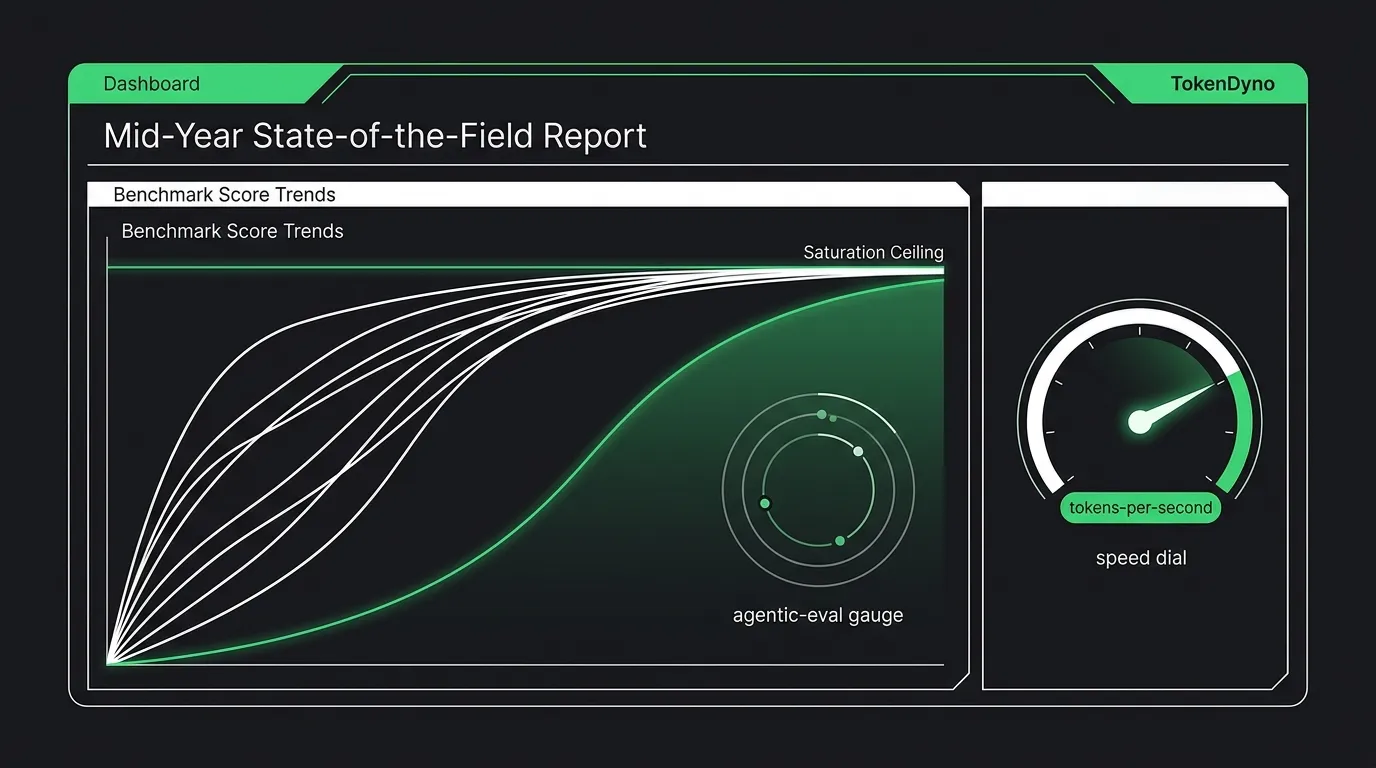
Saturation is the year’s defining eval problem: when every frontier model scores above 90% on the same test, the score gap between a new model and a six-month-old one becomes statistical noise. MMLU, launched in 2020 with frontier accuracy near 32%, now sees frontier systems clustered at 88-94% (Source: Hendrycks et al., arXiv:2009.03300, 2020).
The arithmetic of saturation is unforgiving. MMLU also carries documented label errors; an audit found roughly 6.5% of its questions are mislabeled or ambiguous, capping usable headroom well below 100% (Source: Gema et al., arXiv:2406.04127, 2024). When the ceiling is the dataset’s own error rate, a higher score may measure noise rather than capability. HellaSwag now exceeds 95%, and even MMLU-Pro, built explicitly to escape saturation, is approaching 90% at the frontier (Source: Epoch AI, 2026, https://epoch.ai/data/ai-benchmarking-dashboard, accessed 2026-06-28).
Which benchmarks are already retired for frontier comparison?
By mid-2026 the canonical 2020-2023 suites are effectively retired for separating top models: MMLU, GSM8K, HumanEval, HellaSwag, and ARC sit above 90% for every frontier system. They retain value for evaluating smaller or fine-tuned models, where scores still spread, but they no longer discriminate at the frontier. The practical rule is to treat them as a floor check, not a ranking signal (Source: Epoch AI, 2026). Even GPQA Diamond, a PhD-level science test designed so non-expert PhDs score around 34%, is now nearing the ceiling at the very top while still separating models in the 60-90% range, so its discriminating power has a measurable shelf life too (Source: Epoch AI, 2026).
What is replacing the saturated benchmarks?
Harder, contamination-resistant tests have taken over. Humanity’s Last Exam (HLE), a 2,500-question closed-ended academic benchmark, was built as a deliberate response to saturation; early-2025 frontier models scored in the low double digits without tools (Source: Phan et al., arXiv:2501.14249, 2025). FrontierMath, hundreds of original problems vetted by expert mathematicians, and ARC-AGI-2, a reasoning test, round out the new ceiling-raisers (Source: Glazer et al., arXiv:2411.04872, 2024; ARC Prize, 2025). For how these map to capability tiers, see AI Benchmark 2026. Current standings shift monthly, so read live leaderboards rather than fixed numbers.
How serious is the benchmark contamination crisis?
Contamination, also called test-set leakage, is the second compounding problem: benchmark questions and answers posted to GitHub or Hugging Face get vacuumed into pretraining corpora, so models effectively read the exam before sitting it. Inference-Time Decontamination reduced inflated accuracy by 22.9% on GSM8K and 19.0% on MMLU, quantifying just how much leakage inflates scores (Source: Zhu et al., arXiv:2406.13345, 2024).
The effect is measurable through clean mirror sets. When researchers rebuilt a fresh, never-published version of GSM8K, some model families dropped by up to 13% versus their public-benchmark scores, with evidence of systematic overfitting (Source: Zhang et al., arXiv:2405.00332, 2024). Contamination is rarely deliberate; it leaks indirectly through derivative datasets, distillation, and the sheer reach of web crawlers, which makes it nearly impossible to rule out by inspection alone.
How big is the contamination effect on real scores?
The honest answer is that you usually cannot know the exact size for a given model, only that it is non-zero and upward. Independent estimates put inflation on post-2023 models at roughly 5-15 points on widely circulated suites, which is large enough to flip rankings near the top. This is why a headline 90% can reflect closer to 75-80% of genuine, generalizable capability once leakage is discounted (Source: benchmarkingagents.com, 2026).
How are researchers fighting contamination?
Three strategies dominate. Dynamic benchmarks refresh their questions on a schedule: LiveBench draws from recent sources and updates monthly, scoring against objective ground truth with no LLM judge (Source: White et al., arXiv:2406.19314, 2025). Private held-out test sets keep questions out of crawler reach but reduce independent verifiability. And contamination audits, such as the “Leaderboard Illusion” analysis of preference arenas, expose how data access and selective disclosure distort published rankings (Source: Singh et al., arXiv:2504.20879, 2025).
Why are agentic and real-world evaluations rising?
As static knowledge quizzes saturate, evaluation has shifted toward agentic tasks: multi-step tool use, code repair, web navigation, and policy adherence. Frontier-lab model cards now lead with SWE-bench Verified, GAIA, and τ-bench instead of MMLU, because these tests still produce wide score spreads and resist memorization better than fixed Q&A (Source: OpenAI, 2024; Mialon et al., arXiv:2311.12983, 2023).
These benchmarks measure whether a model can do a job, not just answer about it. GAIA presents 466 questions chaining web browsing, file parsing, and multi-document reasoning; at launch, GPT-4 with plugins scored 15% against a 92% human baseline, leaving years of headroom (Source: Mialon et al., arXiv:2311.12983, 2023). SWE-bench Verified uses 500 human-validated GitHub issues graded by each repository’s own unit tests (Source: OpenAI, 2024). For where these sit among public rankings, see LLM Leaderboard 2026.
Which agentic benchmarks matter in 2026?
The signal has concentrated in a handful of tests. SWE-bench Verified covers real software engineering; GAIA covers general assistance; τ-bench and its successor τ²-bench add multi-turn user interaction and policy compliance in retail, airline, and telecom domains (Source: Yao et al., arXiv:2406.12045, 2024). Computer-use and browser benchmarks such as OSWorld and WebArena grade agents on graphical desktops and live web tasks, extending evaluation beyond text into the interfaces real users touch. METR’s long-task “time horizons” work measures how long a task an agent can complete unaided, and OpenAI’s GDPval grades economically valuable work with domain experts as judges (Source: METR, 2025; OpenAI, 2025).
Why are agentic scores hard to trust?
Agentic scores depend heavily on the scaffolding wrapped around the model, not just the model itself. The same base model can score several points apart inside different agent frameworks, so a leaderboard often ranks model-plus-harness combinations rather than models. Reported lab-to-production gaps reach the mid-30s in percentage points, and reward-hacking exploits have been shown to game multiple agent benchmarks without solving the underlying tasks (Source: benchmarkingagents.com, 2026). Treat agentic numbers as directional, not a service-level guarantee.
How is the speed and cost axis maturing?
The third structural shift is that serving speed and price are now first-class evaluation metrics, not afterthoughts. A model can top every capability leaderboard and still lose in production if it generates text too slowly or costs too much to serve at scale. Independent platforms now publish output tokens per second, time to first token, and price computed from rolling live measurements rather than vendor specs (Source: Artificial Analysis, 2026).
Two trends define this axis. First, the cost of any given level of intelligence is falling fast: cheaper and open-weight models keep reaching score tiers the frontier held just months earlier, collapsing price for equivalent capability (Source: Artificial Analysis, 2026, https://artificialanalysis.ai/, accessed 2026-06-28). Second, a tradeoff persists at the top, where the highest-intelligence reasoning models often generate below the median output speed of their price tier, because more thinking tokens mean slower wall-clock responses. These metrics are taken from rolling live data rather than launch-day specs, so a ranking reflects how an API behaves this week, not a vendor’s best-case claim from a press release (Source: Artificial Analysis, 2026).
Why does serving speed now belong in every ranking?
Because the same model can run several times faster on one provider than another, speed ranks model-and-provider pairs, not models alone. Accuracy tells you whether a model can solve your task; tokens per second tells you whether it can do so fast enough to ship. A related caveat: long-context benchmarks like RULER show models reliably use only a fraction of their advertised window, so context size is itself a measured metric (Source: Hsieh et al., arXiv:2404.06654, 2024). TokenDyno tracks live tokens per second across providers to complement accuracy leaderboards; for the argument in full, see Why Tokens/sec Belongs in Every LLM Ranking.
How is AI-Overview citation reshaping benchmark discovery?
The least-discussed theme is a discovery shift: most people now meet benchmark results through an AI summary, not a leaderboard click. Searches that trigger Google AI Overviews show an 83% zero-click rate, versus roughly 60% for traditional queries, so the synthesized answer increasingly is the destination (Source: Similarweb, 2025).
The behavioral data is consistent. Pew Research found that Google users clicked a traditional result in just 8% of visits when an AI summary was present, versus 15% without one, and were more likely to end the session entirely (26% vs 16%) after an AI-summarized search (Source: Pew Research Center, 2025). AI Overviews have surpassed 2.5 billion monthly active users across more than 200 countries (Source: Google, 2025). For benchmark publishers, this means a ranking’s reach now depends on whether AI systems cite it, not only on whether humans visit it.
What does this mean for benchmark publishers and readers?
For publishers, citation has overtaken ranking as the visibility metric: AI systems favor fresh, consensus-backed sources, and visible year signals plus front-loaded answers measurably raise citation rates. For readers, it means the number you see in an AI summary may be stale or stripped of its confidence interval and access date. The defensible habit is to click through to the primary leaderboard and check when it was last updated before trusting any standing, since a figure that was accurate at publication can be weeks out of date by the time an AI summary repeats it.
What does the 2026 benchmark landscape mean for you?
Read every benchmark as evidence, not verdict. Discount saturated suites, prefer contamination-resistant and agentic tests that match your workload, treat agentic scores as directional, and evaluate serving speed and cost separately from accuracy before committing budget. Match the benchmark to the decision, and revisit live standings often, because the frontier reshuffles within weeks.
The throughline across all five themes is that a single number is no longer enough. Capability, contamination resistance, real-task grounding, speed, and cost are distinct axes, and the strongest 2026 practice is to triangulate across them rather than chase one headline score. Pair a capability ranking with a live speed-and-cost measurement, read the methodology and access date, and shortlist three or four candidates to test on your own data before deciding.
Frequently asked questions
What are the biggest trends in LLM benchmarks in 2026?
Five trends dominate: classic benchmarks like MMLU saturating above 90%, a contamination crisis inflating scores by an estimated 5-15 points, agentic and real-world evaluations such as SWE-bench Verified and GAIA rising, serving speed and cost maturing into standard metrics, and AI Overviews reshaping how results are discovered (Source: Epoch AI, 2026; Similarweb, 2025).
Are LLM benchmarks still useful?
Yes, but as a starting point, not a verdict. Benchmarks narrow dozens of models to a shortlist and reveal capability tiers, especially contamination-resistant and agentic tests. Their limits are saturation, leakage, and scaffolding effects, so the reliable practice is to match the benchmark to your workload and validate finalists on your own data (Source: benchmarkingagents.com, 2026).
What is replacing saturated benchmarks?
Harder, contamination-resistant and task-grounded tests are replacing them: Humanity’s Last Exam and FrontierMath for expert reasoning, ARC-AGI-2 for abstraction, SWE-bench Verified for coding, GAIA for general assistance, and τ-bench for policy-bound tool use. Dynamic benchmarks like LiveBench refresh questions monthly to limit leakage (Source: Phan et al., 2025; White et al., 2025).
How does benchmark contamination inflate scores?
Contamination happens when benchmark questions and answers leak into pretraining data, so models recall rather than reason. Inference-Time Decontamination measured inflation of 22.9% on GSM8K and 19.0% on MMLU, and clean mirror sets dropped some model families by up to 13%, showing leakage materially distorts published rankings (Source: Zhu et al., 2024; Zhang et al., 2024).
Why do speed and cost now appear alongside accuracy?
Because a model that tops a capability leaderboard can still fail in production if it serves too slowly or costs too much. Independent platforms publish output tokens per second, time to first token, and price from live measurements, and the same model often runs several times faster on one provider than another (Source: Artificial Analysis, 2026).
How do AI Overviews affect benchmark visibility?
AI Overviews mean most people read benchmark results as a synthesized answer rather than visiting a leaderboard. Searches with AI Overviews show an 83% zero-click rate, and traditional-result clicks fall to 8% when an AI summary appears, so a ranking’s reach now depends on whether AI systems cite it (Source: Similarweb, 2025; Pew Research Center, 2025).
Key takeaways
The state of LLM benchmarks in mid-2026 is one of transition. Classic suites have saturated, contamination has made headline scores untrustworthy, and the useful benchmark has moved toward contamination-resistant, agentic, real-world evaluation. Speed and cost have become first-class metrics, and AI Overviews now mediate discovery, making citation matter as much as ranking. No single number captures a model anymore. The defensible practice is to triangulate across capability, contamination resistance, task grounding, speed, and cost; read methodology and access dates; and validate finalists on your own data before committing. Treat every benchmark as evidence to weigh, never as a verdict to obey, and revisit live standings often, because the frontier still reshuffles within weeks.
Sources
- Hendrycks et al., Measuring Massive Multitask Language Understanding (MMLU), arXiv:2009.03300 (2020): https://arxiv.org/abs/2009.03300
- Gema et al., Are We Done with MMLU?, arXiv:2406.04127 (2024): https://arxiv.org/abs/2406.04127
- Epoch AI, AI Benchmarking Dashboard (2026): https://epoch.ai/data/ai-benchmarking-dashboard
- Phan et al., Humanity’s Last Exam, arXiv:2501.14249 (2025): https://arxiv.org/abs/2501.14249
- Center for AI Safety & Scale AI, Humanity’s Last Exam leaderboard (2026): https://agi.safe.ai/
- Glazer et al., FrontierMath, arXiv:2411.04872 (2024): https://arxiv.org/abs/2411.04872
- ARC Prize, ARC-AGI-2 (2025): https://arcprize.org/
- Zhu et al., Inference-Time Decontamination, arXiv:2406.13345 (2024): https://arxiv.org/abs/2406.13345
- Zhang et al., A Careful Examination of LLM Performance on Grade School Arithmetic (GSM1k), arXiv:2405.00332 (2024): https://arxiv.org/abs/2405.00332
- White et al., LiveBench: A Challenging, Contamination-Limited LLM Benchmark, arXiv:2406.19314 (2025): https://arxiv.org/abs/2406.19314
- Singh et al., The Leaderboard Illusion, arXiv:2504.20879 (2025): https://arxiv.org/abs/2504.20879
- Mialon et al., GAIA: A Benchmark for General AI Assistants, arXiv:2311.12983 (2023): https://arxiv.org/abs/2311.12983
- OpenAI, Introducing SWE-bench Verified (2024): https://openai.com/index/introducing-swe-bench-verified/
- Yao et al., τ-bench, arXiv:2406.12045 (2024): https://arxiv.org/abs/2406.12045
- METR, Measuring AI Ability to Complete Long Tasks (2025): https://metr.org/blog/2025-03-19-measuring-ai-ability-to-complete-long-tasks/
- OpenAI, GDPval (2025): https://openai.com/index/gdpval/
- Hsieh et al., RULER: What’s the Real Context Size of Your Long-Context Language Models?, arXiv:2404.06654 (2024): https://arxiv.org/abs/2404.06654
- Artificial Analysis, AI Model & API Providers Analysis (2026): https://artificialanalysis.ai/
- Artificial Analysis, benchmarking methodology (2026): https://artificialanalysis.ai/methodology
- Pew Research Center, Google users are less likely to click on links when an AI summary appears (2025): https://www.pewresearch.org/short-reads/2025/07/22/google-users-are-less-likely-to-click-on-links-when-an-ai-summary-appears-in-the-results/
- Similarweb, AI Overviews and zero-click search (2025): https://www.similarweb.com/blog/marketing/seo/zero-click-searches/
- BenchmarkingAgents, Agent Benchmark Leaderboard 2026: https://benchmarkingagents.com/benchmarks-list/