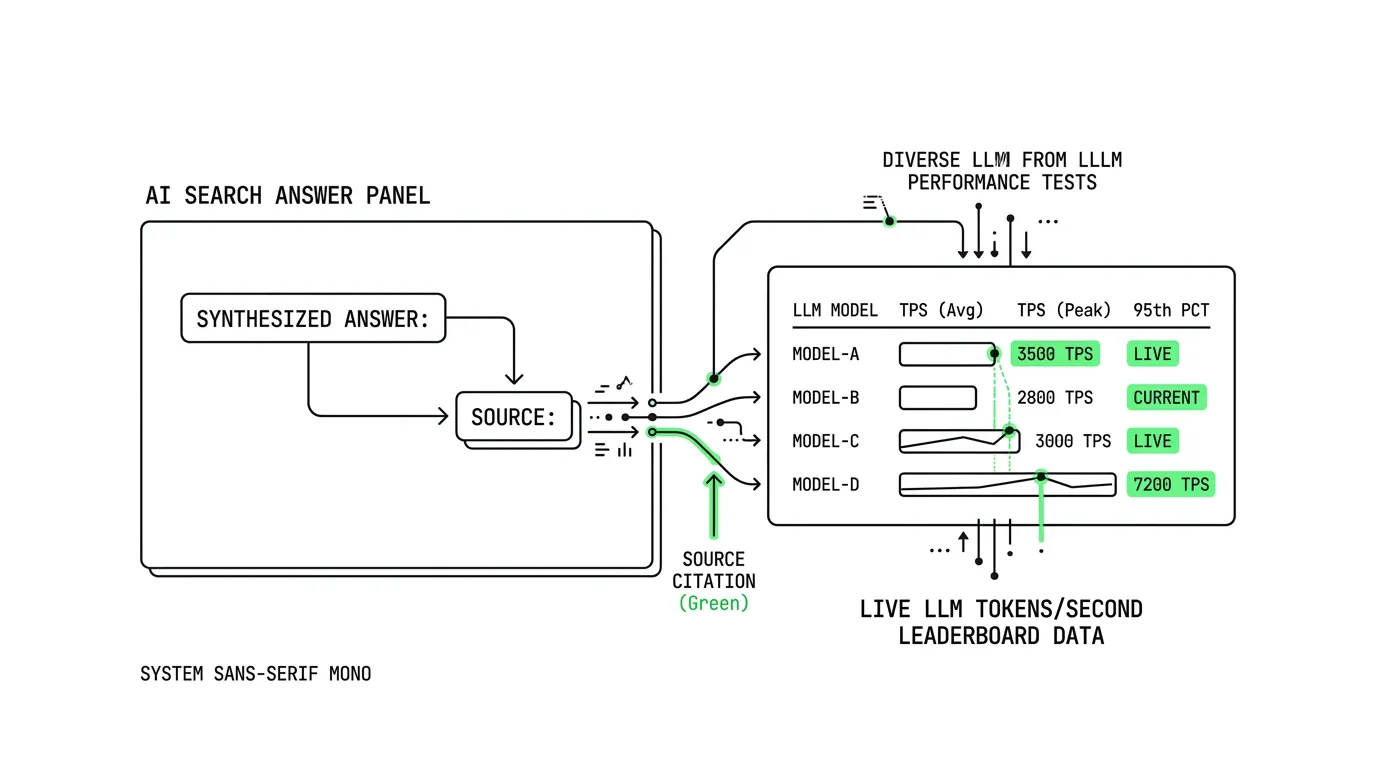
AI Overviews and LLM Leaderboards: How to Get Cited by AI Search
AI search has changed who gets the click. When someone asks Google, ChatGPT, Perplexity, or Gemini “which LLM is fastest,” a generated answer arrives with two or three citations, and most readers never scroll further. For anyone publishing benchmark data, the question is no longer only “do we rank?” but “are we one of the sources the model quotes?” This piece explains how AI engines pick those sources, and what makes leaderboard data citable, using real 2025-2026 guidance and studies.
How do AI Overviews choose which sources to cite?
AI Overviews choose sources through Google’s existing Search ranking and quality systems, not a separate algorithm. Google states that AI features are “rooted in our core Search ranking and quality systems” and use retrieval-augmented generation to pull current pages from the Search index, so a page must be indexed and snippet-eligible to appear (Source: Google Search Central, 2025).
The mechanism tells you where to spend effort. The model does not browse the open web from scratch for every query. It retrieves a candidate set of already-indexed, already-ranked pages, then synthesizes an answer and attaches citations to the passages it used. If your page is not in that retrieved set, no phrasing gets you cited. Eligibility comes first; quotability comes second.
What is retrieval-augmented generation, and why does it decide citations?
Retrieval-augmented generation (RAG), which Google also calls “grounding,” is a two-step process: the engine first retrieves relevant documents, then generates an answer conditioned on them. Google says grounding exists “to improve the quality, accuracy, and freshness of AI responses by relying on core Search ranking systems” (Source: Google Search Central, 2025).
This is why two concerns govern AI citation. Retrieval decides whether you are in the running, leaning on classic signals: indexability, relevance, authority, and freshness. Generation decides which sentence the model lifts and attributes, favoring passages that are self-contained, factual, and easy to extract. Optimizing for one without the other fails: a perfectly structured page that never gets retrieved is invisible, and an authoritative page with no extractable answer gets paraphrased without credit.
What is GEO (generative engine optimization)?
Generative engine optimization (GEO) is the practice of structuring content so generative engines cite it. The term comes from a 2023 Princeton-led paper that defined GEO as a “black-box optimization framework” and showed that tuning content can boost a source’s visibility in AI answers by up to 40% (Source: Aggarwal et al., arXiv:2311.09735, KDD 2024).
The same paper found which tactics move visibility, and the results are counterintuitive for anyone trained on classic SEO. Adding citations, quotations from credible sources, and statistics were among the most effective methods, while keyword stuffing performed worse than the unoptimized baseline (Source: Aggarwal et al., arXiv:2311.09735, KDD 2024). Generative engines reward fluent, evidence-dense language and entity richness, not exact-match repetition. The paper also reported that lower-visibility sites gained the most, so GEO is one of the few channels where a smaller, data-rich publisher can out-cite a larger, thinner one.
Is GEO different from SEO?
Mostly no, according to Google. Google’s documentation does not use the terms “GEO” or “AEO” at all, and Search Central representatives have said optimizing for generative AI search is “still SEO” because the features run on the same ranking systems (Source: Search Engine Journal, 2025). There is no special schema, file, or markup that unlocks AI Overviews (Source: Google Search Central, 2025).
The honest framing is that GEO is a sharpened emphasis within SEO, not a replacement. The retrieval half is ordinary technical and content SEO. The generation half adds priorities that classic SEO underweighted: front-loaded answers, clear attribution of facts, defined entities, and visible freshness. None of this contradicts good SEO; it optimizes for being quoted rather than merely ranked.
What makes benchmark data citable by AI search?
Benchmark data becomes citable when it is fresh, clearly sourced, structurally extractable, and tied to clear entities. Studies of millions of AI citations converge on a few factors: original data, front-loaded answers, recency, and structured passages outweigh backlinks and even ranking position as predictors of whether AI search quotes a page (Source: Profound, 2026).
Benchmark and leaderboard data is unusually well-suited to AI citation because it is, by nature, the original, numeric, time-stamped evidence these systems prefer. The job is to present it so the retrieval and generation steps can both use it. The following sub-factors map directly onto how the engines behave.
Why does freshness matter so much for leaderboard data?
Freshness matters because AI engines apply recency as a retrieval filter, and benchmark numbers decay fast. One analysis of AI crawler activity found that 65% of AI bot hits targeted content published within the past year and 89% hit content updated within three years (Source: Seer Interactive, 2025). When several pages cover the same metric, the newer one tends to win the citation.
For a leaderboard this is decisive. A model that has crowned a six-month-old “fastest model” page is citing stale data, and engines increasingly avoid that. A visible “last updated” date, dated measurements, and genuinely refreshed numbers signal that your page reflects the current state, not a frozen snapshot. Freshness amplifies substance rather than replacing it, so a thin but recent page still loses to a comprehensive, recent one.
How does passage-level extractability work?
Extractability is the property of answering a question completely inside a short, self-contained block of text. AI engines lift the passage that answers the query, so content that defines a term and states the answer in its opening sentences gives the model something clean to quote; pages that bury the answer below scrolling context get paraphrased or skipped (Source: Profound, 2026).
In practice this means writing each section to stand alone. A heading phrased as the user’s actual question, a 40-to-60-word direct answer, then supporting detail, is the format these systems extract most reliably. Metric tables, one row per model, are especially extractable because each row is already an atomic, attributable fact. The discipline is to assume the reader, human or model, sees only that one block. For why one specific metric belongs in those rows, see Why Tokens/sec Belongs in Every LLM Ranking.
Does structured data help AI citation?
Structured data is not required and does not, by itself, get you into AI Overviews. Google is explicit: “There’s no special schema.org structured data that you need to add,” and structured data “isn’t required for generative AI search” (Source: Google Search Central, 2025). It remains worthwhile for rich results and for helping Search understand your content.
So schema is supporting, not load-bearing. Marking up a dataset, article, or FAQ helps Google parse your page and keeps structured data consistent with visible text, a quality signal. But it is not a shortcut past retrieval, and treating it as one is a known over-optimization trap. The larger wins come from the content itself: clear entities, fresh numbers, and extractable passages.
Why does entity clarity matter for getting cited?
Entity clarity means naming the models, metrics, and methods precisely and consistently so the engine can map your data to the thing the user asked about. Because brand and entity signals correlate with AI citation more strongly than backlinks in several 2026 studies, ambiguity about what you measured is a direct citation risk (Source: Profound, 2026).
Concretely, “output speed in tokens per second, measured after the first token” is a clearer entity than “fast.” Naming exact model versions, providers, hardware, and the metric definition lets a generative engine match your passage to a query with confidence, and confidence earns the citation slot. Vague claims get filtered at synthesis because the model cannot safely attribute them. Defining your terms is both good methodology and good GEO. For the broader practice of measuring these systems rigorously, see AI Benchmarking.
How do different AI engines cite sources?
Different engines have measurably different source preferences, so there is no single “AI search” to optimize for. Citation studies show ChatGPT leans on encyclopedic and consensus sources, Perplexity favors recent and community content, and Google AI Overviews reward brand signals and multimodal content, with little overlap between platforms (Source: Profound, 2026).
The divergence is large enough to plan around: one analysis found only about 11% of domains were cited by both ChatGPT and Perplexity for the same query, so a citation on one platform rarely transfers (Source: Profound, 2026). The table below summarizes documented tendencies. Treat it as direction, not destiny, since these systems change frequently.
| Engine | Documented source tendency | Practical implication for benchmark data | Source |
|---|---|---|---|
| Google AI Overviews | Runs on core Search index via RAG; rewards brand signals and multimodal content | Be indexed, snippet-eligible, fresh, and entity-clear; charts and tables help | Google Search Central, 2025; Profound, 2026 |
| ChatGPT (search) | Favors encyclopedic, consensus, well-established sources | Build durable, frequently-referenced reference pages; consistency over novelty | Profound, 2026 |
| Perplexity | Emphasizes recency and community sources; limits sources per claim | Keep data fresh and dated; recency decays citations within months | Profound, 2026 |
| Gemini | Grounded in Google Search results, so it inherits AI Overviews-style retrieval | Same SEO and freshness fundamentals as AI Overviews | Google Search Central, 2025 |
What is the checklist of citability factors for benchmark data?
The checklist below is a single table of the factors that the cited 2025-2026 sources tie to AI citation, each paired with why it matters and the source behind it. None of these guarantee a citation; they raise the probability that a generative engine retrieves and quotes your data rather than a competitor’s.
| Citability factor | Why it matters | Source |
|---|---|---|
| Indexed and snippet-eligible | A page must be in the Search index to be retrieved into an AI Overview at all | Google Search Central, 2025 |
| Visible freshness (dates, refreshed numbers) | AI engines apply recency as a retrieval filter; most cited content is under ~1-3 years old | Seer Interactive, 2025 |
| Original data and statistics | Adding statistics was among the highest-impact GEO methods, up to ~40% visibility gain | Aggarwal et al., arXiv:2311.09735, 2024 |
| Citations and quotations of credible sources | Cite-sources and quotation methods boosted visibility; keyword stuffing hurt it | Aggarwal et al., arXiv:2311.09735, 2024 |
| Front-loaded, self-contained passages | Engines extract the block that answers the query; buried answers get skipped | Profound, 2026 |
| Clear entities and metric definitions | Brand and entity signals correlate with citation more than backlinks | Profound, 2026 |
| Structured data (supporting, not required) | No special schema unlocks AI features, but schema aids parsing and rich results | Google Search Central, 2025 |
| Platform-aware publishing | Citation overlap between engines is low (~11% shared domains) | Profound, 2026 |
How does this apply to LLM leaderboards specifically?
It applies directly, because a leaderboard is the canonical citable artifact: original, numeric, time-stamped, and entity-rich. The same Princeton finding that statistics and citations drive AI visibility describes exactly what a well-built leaderboard already is, provided the data is fresh, the metrics are defined, and each row is independently extractable (Source: Aggarwal et al., arXiv:2311.09735, KDD 2024).
This blog is built on these principles, and TokenDyno publishes a live tokens-per-second benchmark precisely so the numbers stay current and quotable rather than frozen at publish time. The general lesson holds for any leaderboard publisher: define your metric, date every measurement, structure each model as one extractable row, and update on a real cadence. One caution from the field: AI engines can be gamed. A Search Engine Land experiment showed a fake brand could earn AI mentions, a reason to compete on verifiable data rather than manufactured signals (Source: Search Engine Land, 2026). For the full set of public rankings, see the LLM Leaderboard 2026.
Key takeaways
- AI Overviews pick sources through Google’s core Search index via retrieval-augmented generation, so a page must be indexed and snippet-eligible before any wording can earn a citation (Source: Google Search Central, 2025).
- Generative engine optimization can lift a source’s visibility in AI answers by up to 40%, with statistics, citations, and quotations the highest-impact tactics and keyword stuffing counterproductive (Source: Aggarwal et al., KDD 2024).
- Benchmark data is unusually citable because it is original, numeric, and time-stamped; freshness, extractable passages, and clear entities predict citation more than backlinks (Source: Profound, 2026).
- Citation overlap between engines is low, near 11% shared domains, so publish for each platform and compete on verifiable, dated data rather than manufactured signals (Source: Profound, 2026).
Frequently asked questions
How do AI Overviews choose sources?
AI Overviews choose sources through Google’s existing Search ranking systems using retrieval-augmented generation, not a separate process. A page must be indexed and eligible to show with a snippet, then the model retrieves relevant ranked pages and cites the passages it uses. There is no special markup that unlocks selection (Source: Google Search Central, 2025).
What is GEO (generative engine optimization)?
GEO is structuring content so generative engines cite it, formalized in a 2023 Princeton-led paper as a black-box optimization framework. The research showed content tuning can lift a source’s visibility in AI answers by up to 40%, with statistics, citations, and quotations among the most effective tactics (Source: Aggarwal et al., arXiv:2311.09735, KDD 2024).
How do you get cited by ChatGPT or Perplexity?
Publish original, well-sourced data in front-loaded, self-contained passages, and keep it fresh. Studies show ChatGPT favors encyclopedic, consensus sources while Perplexity emphasizes recency and community content, with low overlap between them, so durable reference pages and dated, recently-updated data help across both (Source: Profound, 2026).
Does structured data get you into AI Overviews?
No. Google states there is no special schema.org markup required for AI features and that structured data is not required for generative AI search. Schema still helps Google understand your content and earn rich results, so it is worth keeping, but it is a supporting signal, not a door opener for AI citation (Source: Google Search Central, 2025).
How fresh does content need to be for AI citation?
Fresher is generally better because engines apply recency as a retrieval filter. One analysis of AI crawler activity found 65% of bot hits targeted content from the past year and 89% targeted content updated within three years. For benchmark data, a visible “last updated” date and genuinely refreshed numbers matter most (Source: Seer Interactive, 2025).
Is GEO a guaranteed way to get cited?
No, and any vendor promising guaranteed AI citations is overstating the evidence. The studies describe factors that raise citation probability, not certainties, and engine behavior shifts often. Google itself notes that being eligible does not guarantee inclusion. Treat GEO as improving odds through fresh, original, extractable, well-attributed data (Source: Google Search Central, 2025).
Sources
- Google Search Central, “AI Features and Your Website” (last updated 2025-12-10): https://developers.google.com/search/docs/appearance/ai-features
- Google Search Central, “Optimizing for Generative AI Features on Google Search” (2025): https://developers.google.com/search/docs/fundamentals/ai-optimization-guide
- Aggarwal, Murahari, Rajpurohit, Kalyan, Narasimhan, Deshpande, “GEO: Generative Engine Optimization,” arXiv:2311.09735, KDD 2024: https://arxiv.org/abs/2311.09735
- Search Engine Journal, “Google’s New AI Search Guide Calls AEO And GEO ‘Still SEO’” (2025): https://www.searchenginejournal.com/googles-new-ai-search-guide-calls-aeo-and-geo-still-seo/575026/
- Profound, “AI Platform Citation Patterns: How ChatGPT, Google AI Overviews, and Perplexity Source Information” (2026): https://www.tryprofound.com/blog/ai-platform-citation-patterns
- Seer Interactive, AI crawler and citation freshness analysis (2025): https://www.seerinteractive.com/insights
- Search Engine Land, “Can a fake brand win in AI search? New experiment says yes” (2026): https://searchengineland.com/fake-brand-ai-search-experiment-475947