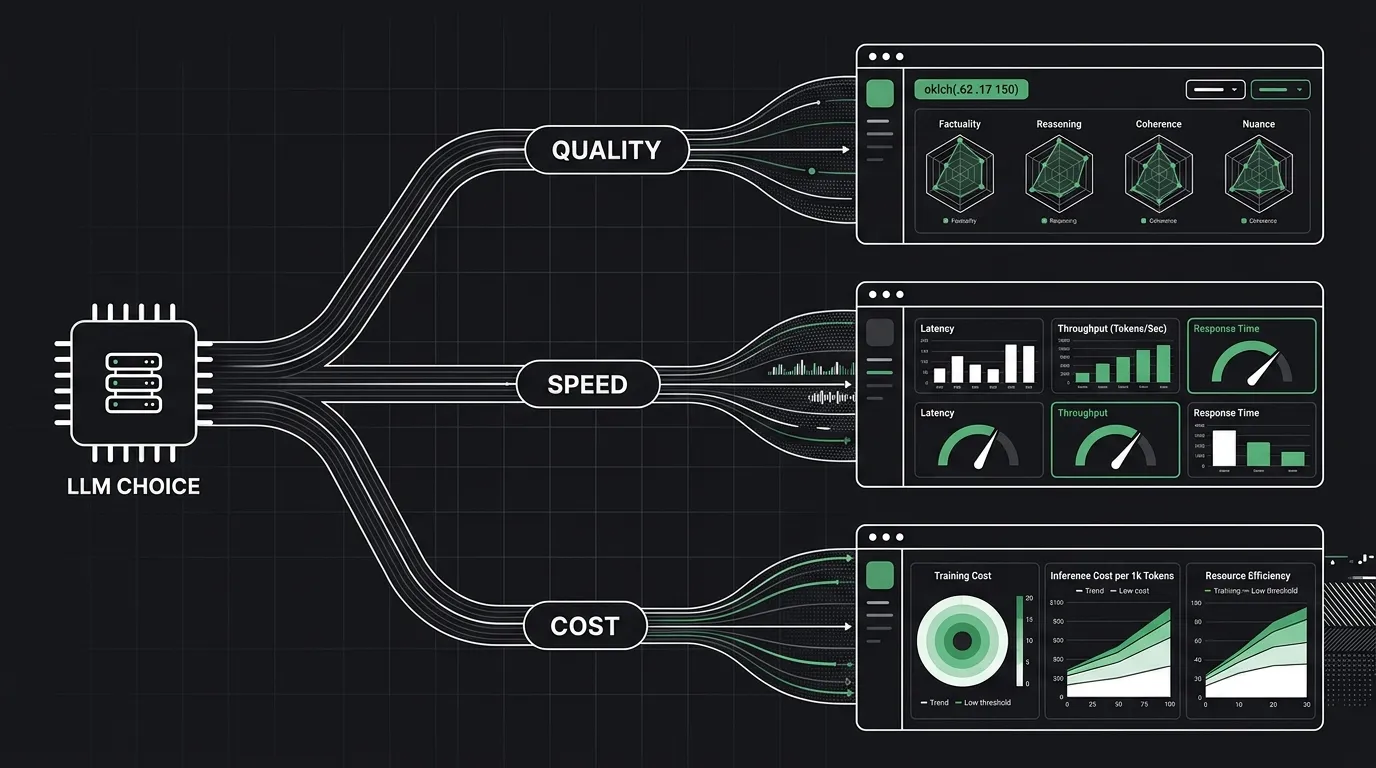
Speed, Quality, or Both? Choosing the Right LLM Benchmark
Most teams read the wrong benchmark for their problem. They compare frontier reasoning scores when their product is a latency-bound voice agent, or they chase throughput when accuracy decides revenue. The cost spread alone makes the stakes concrete: in mid-2026, the same Intelligence Index task ran for $0.04 on DeepSeek V4 Pro versus $1.78 on Claude Opus 4.8, a 40x gap (Source: Artificial Analysis, 2026). The right benchmark is the one tied to your binding constraint.
This is a decision guide, not a leaderboard. A separate post covers how to run an LLM benchmark comparison mechanically; this one answers the prior question: what should you optimize at all? We map use cases to one priority, quality, speed, or cost, then to the benchmark that measures it, with a decision matrix you can apply in minutes.
Should you optimize for LLM speed or quality?
Optimize for whichever one fails your use case first. If wrong answers lose customers or create liability, quality is the binding constraint and speed is a tiebreaker. If users abandon on lag, speed binds and a small quality gap is invisible. Most products have exactly one constraint that decides success; find it before you open a single benchmark.
The trap is optimizing both equally. They trade off in practice: reasoning-tier models that top quality benchmarks are often the slowest, because the same “thinking” tokens that lift accuracy also inflate latency. In late 2025, Claude Opus 4.5 in non-reasoning mode measured 45.4 tokens/sec while Gemini 3 Pro output around 146, roughly the inverse of how close they sat on coding quality (Source: Artificial Analysis, 2025). Picking a primary axis is what makes the decision tractable.
When does inference speed matter more than accuracy?
Speed outranks accuracy when latency is part of the user experience and the task is well within the model’s competence. Real-time voice, autocomplete, live chat, and high-fan-out agent loops all qualify: the answer is usually easy enough that any frontier model gets it right, so the differentiator is how fast the first token arrives.
The thresholds are specific. For a voice agent, the LLM component should hit time-to-first-token of 150-300ms, and end-to-end response under roughly 700ms feels human, with abandonment climbing past 1.2 seconds (Sources: Retell AI, 2025; Twilio, 2025). Time to first token, not total throughput, is the metric, because speech synthesis starts as soon as the first tokens stream (Source: IBM, 2025). In agent pipelines the effect compounds: a four-step loop at 600ms TTFT per step adds 2.4 seconds of pure first-token latency before any work happens.
Which use cases are latency-bound?
A use case is latency-bound when a human waits on the output in real time, or when the model is called many times in series. Voice assistants, IDE autocomplete, customer-facing chat, and multi-hop agents fit. For these, a 2-point quality edge is worthless if it costs 200ms per call.
The tell is whether your p95 latency budget is tighter than your accuracy tolerance. If the task is “summarize this support ticket conversationally” and every frontier model handles it, you are buying speed, not intelligence. Benchmark the axis that moves your number: tokens/sec and TTFT, measured on your actual provider endpoint, not a vendor’s marketing chart.
When is accuracy non-negotiable?
Accuracy binds when an error is expensive, irreversible, or hard to detect: medical triage, legal drafting, financial calculation, code that ships to production, or anything a human will trust without rechecking. Here a slower, more capable model pays for itself because one avoided mistake outweighs thousands of fast responses.
In these domains, prefer benchmarks that discriminate at the top. MMLU is effectively saturated, with frontier models clustered above 88%, which is why Artificial Analysis dropped it as outdated (Source: Artificial Analysis, 2026). GPQA Diamond and domain-specific suites still spread the leaders apart, so they tell you something a saturated test cannot.
When does cost decide the LLM benchmark you should read?
Cost decides when the workload runs at volume and the quality difference between candidates is small. At scale, a 40x price gap dwarfs a few points of benchmark score: DeepSeek V4 Pro completed an Intelligence Index task for $0.04 versus $0.99 for GPT-5.5 and $1.78 for Opus 4.8, while landing within a handful of points on the index (Source: Artificial Analysis, 2026). For high-volume classification or extraction, that ratio is the whole decision.
Cost is also why per-task and per-token metrics matter more than headline intelligence for many buyers. Artificial Analysis added Cost per Task to its v4.1 methodology precisely because blended token prices hide how much “thinking” a reasoning model spends to reach an answer (Source: Artificial Analysis, 2026). Two models at the same quality tier can differ 4x in cost-to-run because one is more verbose. The benchmark to read is the cost-efficiency chart, not the raw quality ladder.
How do you weigh cost against quality at scale?
Weigh them by total spend at projected volume, not unit price. A cheaper model that needs a retry or a human review on 5% of calls can cost more than a pricier one that gets it right the first time. Model the full pipeline cost, including failures, before ranking on price.
The honest frame is a floor, not a minimum. Set the quality bar your use case demands, eliminate every model below it, then optimize cost among the survivors. Buying the cheapest model that clears the bar beats buying the cheapest model outright, because below the bar the savings are illusory.
How do you choose an LLM benchmark for your use case?
Choose the benchmark that measures your binding constraint, then validate on your own data. Identify whether quality, speed, or cost decides success, map that axis to one or two benchmarks that still discriminate between current models, confirm the scores were measured under matched conditions, then run your finalists on your real prompts. The benchmark shortlists; your workload chooses.
This inverts the usual habit of starting from a leaderboard. Leaderboards answer “which model is best in general,” a question almost no buyer actually has. Your question is “which model is best for my one constraint at my volume.” The framework below makes that explicit and auditable, so you can defend the choice and rerun it when models change. For why throughput deserves a column at all, see Why Tokens/sec Belongs in Every LLM Ranking.
What is the LLM benchmark decision matrix?
The matrix maps a use case to its primary constraint, then to the benchmark that measures it. Use it as a starting shortlist, not a verdict; the scores go stale within a release cycle, so always confirm on the live source before committing.
| Use case | Prioritize | Recommended benchmark | Source |
|---|---|---|---|
| Real-time voice agent | Speed (TTFT) | Time-to-first-token + tokens/sec on your endpoint | Retell AI, 2025; IBM, 2025 |
| IDE autocomplete / inline suggest | Speed | Output tokens/sec (live) | Artificial Analysis, 2025 |
| High-volume classification / extraction | Cost | Cost per Task (Intelligence Index v4.1) | Artificial Analysis, 2026 |
| Production coding agent | Quality | SWE-bench Verified | SWE-bench, 2025 |
| Research / graduate-level reasoning | Quality | GPQA Diamond | Artificial Analysis, 2026 |
| Long-context document analysis | Quality | AA-LCR (long-context reasoning) | Artificial Analysis, 2026 |
| Agentic / tool-use workflows | Quality + cost | Terminal-Bench 2.1, τ³-Bench | Artificial Analysis, 2026 |
| General assistant at scale | Cost + quality floor | Intelligence Index + Cost per Task | Artificial Analysis, 2026 |
Which benchmarks discriminate between current models?
Use benchmarks that still spread the leaders apart, and drop the saturated ones. In the Intelligence Index v4.1, the heaviest-weighted evaluations are GDPval-AA v2 at 20%, Terminal-Bench 2.1 at 16%, and τ³-Bench Banking at 14%, all agentic and tool-use heavy, because those are where 2026 models actually differ (Source: Artificial Analysis, 2026). GPQA carries only 6% precisely because reasoning is converging.
For speed, no static leaderboard substitutes for measurement on your own provider, since serving throughput drifts with load and infrastructure. A periodic third-party snapshot and a continuous live tracker can legitimately disagree on the same model. Tools like TokenDyno measure tokens/sec live for this reason; treat any single speed figure as a sample, not a constant, and re-measure on the endpoint you will ship on.
Why not just optimize for everything at once?
Because the axes trade off, and a model that wins all three rarely exists at a given moment. The frontier splits: in late 2025 Gemini 3 Pro led reasoning, Claude Opus 4.5 led coding, and speed inverted both orders (Sources: Google, 2025; Anthropic, 2025; Artificial Analysis, 2025). Demanding the best of every axis means either overpaying for capability you do not use, or shipping latency your users will not tolerate.
The discipline is to pick one primary axis, set floors on the others, and stop. A latency-bound product picks speed, sets a quality floor it must clear, and ignores the top of the reasoning leaderboard. A liability-bound product picks quality, sets a latency ceiling, and pays for it. This is the synthesis of the whole comparison question: benchmarks do not rank models in the abstract, they rank them against your one constraint. For the deeper “what makes a benchmark good” question, see Best LLM Benchmark.
Frequently asked questions
Should I optimize for LLM speed or quality?
Optimize for whichever fails your use case first. If a wrong answer loses revenue or creates liability, quality binds and speed is a tiebreaker. If users abandon on lag, speed binds and a 2-point quality gap is invisible. Identify the single constraint that decides success, then benchmark that axis and set a floor on the other.
When does inference speed matter more than accuracy?
When a human waits on the output in real time and the task is easy enough that any frontier model gets it right. Voice agents need LLM time-to-first-token of 150-300ms and end-to-end response under about 700ms to feel human (Sources: Retell AI, 2025; Twilio, 2025). There, throughput beats a marginal accuracy edge every time.
How do I choose an LLM benchmark?
Identify your binding constraint, quality, speed, or cost, then pick one or two benchmarks that measure it and still spread current models apart. Confirm scores were taken under matched conditions, then validate your top one or two finalists on your own prompts, traffic, and latency budget. The benchmark shortlists; your workload makes the final call.
When does cost decide which benchmark I should read?
When you run at volume and the quality difference between candidates is small. In 2026 the cost to complete one Intelligence Index task ranged from $0.04 to $1.78, a 40x spread, for models only a few points apart (Source: Artificial Analysis, 2026). At scale, read the Cost per Task chart, not the raw intelligence ladder.
Are saturated benchmarks like MMLU still useful?
Rarely, for frontier comparison. Top models now cluster above 88% on MMLU, so it no longer separates them, which is why Artificial Analysis dropped it as outdated (Source: Artificial Analysis, 2026). Use benchmarks that still discriminate, such as GPQA Diamond for reasoning or Terminal-Bench for agents, when the leaders are close.
Can one model win speed, quality, and cost together?
Almost never at the same moment. The axes trade off: reasoning models that top quality benchmarks tend to be slowest and priciest to run. In late 2025 Gemini 3 Pro led reasoning while Claude Opus 4.5 led coding and trailed on speed (Sources: Google, 2025; Anthropic, 2025; Artificial Analysis, 2025). Pick one primary axis and set floors on the rest.
Key takeaways
Choosing an LLM benchmark is a constraint problem, not a leaderboard lookup. Find the one axis, quality, speed, or cost, that decides whether your use case succeeds, map it to a benchmark that still discriminates between current models, set floors on the other axes, and validate finalists on your own workload. The decision matrix above turns that into a minutes-long shortlist.
The axes genuinely trade off: in 2025-2026, frontier models that led reasoning trailed on speed, and a 40x cost spread separated models only a few points apart in quality (Sources: Artificial Analysis, 2025; Artificial Analysis, 2026). That is exactly why optimizing everything at once fails. Pick your binding constraint, read the benchmark that measures it, and let your own evaluation, on your traffic and your latency budget, choose the winner.
Sources
- Artificial Analysis, “Intelligence Index v4.1: a shift toward agentic workloads” (2026): https://artificialanalysis.ai/articles/artificial-analysis-intelligence-index-v4-1
- Artificial Analysis, Intelligence Benchmarking Methodology (2026): https://artificialanalysis.ai/methodology/intelligence-benchmarking
- Artificial Analysis, “Claude Opus 4.5: Benchmarks and Analysis” (2025): https://artificialanalysis.ai/articles/claude-opus-4-5-benchmarks-and-analysis
- Artificial Analysis, model and provider pages (2025-2026): https://artificialanalysis.ai/models
- Anthropic, “Claude Opus 4.5 System Card” (2025): https://assets.anthropic.com/m/64823ba7485345a7/Claude-Opus-4-5-System-Card.pdf
- Google, “Gemini 3” official announcement (2025): https://blog.google/products/gemini/gemini-3/
- SWE-bench, “Verified” definition (2025): https://www.swebench.com/verified.html
- IBM, “Time to First Token (TTFT)” (2025): https://www.ibm.com/think/topics/time-to-first-token
- Retell AI, “How Real-Time Voice AI Actually Works (STT → LLM → TTS)” (2025): https://www.retellai.com/blog/how-real-time-voice-ai-works-stt-llm-tts
- Twilio, “Core Latency in AI Voice Agents” (2025): https://www.twilio.com/en-us/blog/developers/best-practices/guide-core-latency-ai-voice-agents