Best LLM Benchmark: Which to Use for Your Use Case
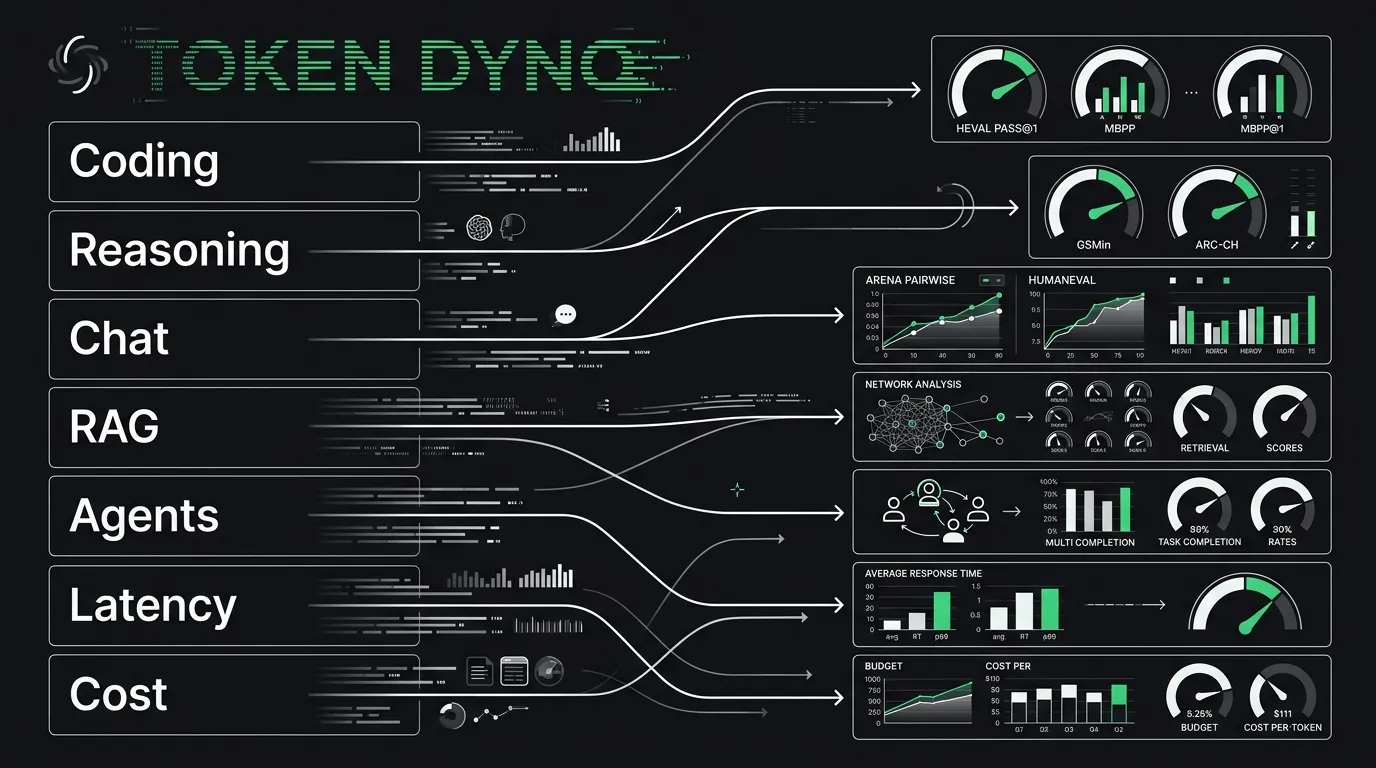
Search “best LLM benchmark” and you get a ranked list, as if one test settled the question. It does not. A benchmark measures one skill under one set of conditions, and a model that tops a coding leaderboard can lag on factuality or serve tokens too slowly to ship. The best benchmark is the one that matches the job your model has to do. This roundup pairs seven common use cases with the benchmark most worth trusting for each, names a real source for every one, and adds the caveat that keeps you from over-reading a single number.
What is the best LLM benchmark?
There is no single best LLM benchmark. The right one depends on the use case: SWE-bench Verified for coding, GPQA Diamond for hard reasoning, Chatbot Arena (LMArena) for open-ended chat, FRAMES for retrieval-augmented factuality, tau-bench for tool-using agents, and tokens-per-second plus time-to-first-token for latency-sensitive products. Each measures a distinct, non-interchangeable skill.
The mistake is treating “best” as a property of the benchmark instead of a property of the match between benchmark and workload. Leaderboards encourage this by stacking every model into one column, but the column you should read changes with what you are building. A retrieval chatbot and a background code-fixing agent share almost no evaluation criteria. Before picking a number to optimize, write down the task, then choose the test that most closely simulates it. For the broader framework, see LLM Benchmark Comparison.
How to read this roundup
This roundup is organized by use case, not by model. Each section names the workload, recommends the benchmark that best simulates it, says in one line what it measures, cites a verifiable source, and ends with a caveat. The covered use cases are coding, reasoning, open-ended chat, RAG and factuality, tool-using agents, real-time latency, and cost. Most production teams care about two or three at once, which is the real argument against a single “best.”
Use case to benchmark, at a glance
| Use case | Recommended benchmark | Why it fits | Source |
|---|---|---|---|
| Coding | SWE-bench Verified | Resolving real GitHub issues, human-validated | OpenAI, 2024 |
| Reasoning | GPQA Diamond | Google-proof PhD-level science questions | Rein et al., 2023 |
| Open-ended chat | Chatbot Arena (LMArena) | Blind human pairwise preference voting | Chiang et al., 2024 |
| RAG / factuality | FRAMES | End-to-end retrieval, factuality, multi-hop reasoning | Krishna et al., 2025 |
| Tool-using agents | tau-bench / tau²-bench | Multi-turn tool calls under policy constraints | Yao et al. / Sierra, 2024 |
| Real-time / latency | Tokens/sec + TTFT | Throughput and time-to-first-token under load | Artificial Analysis, 2026 |
| Cost-sensitive | Intelligence-vs-price (cost per task) | Quality plotted against dollars per task | Artificial Analysis, 2026 |
Which benchmark is best for coding?
For coding, the most trusted benchmark is SWE-bench Verified, a 500-task subset of real GitHub issues that human annotators confirmed are solvable and correctly graded. A model passes only when its patch makes the repository’s hidden tests go green, so it measures end-to-end issue resolution rather than isolated function writing (Source: OpenAI, 2024).
SWE-bench Verified earns the top spot because it simulates the actual job: read a bug report, navigate a real codebase, and ship a patch that passes tests. OpenAI built the Verified subset with professional developers after the original SWE-bench was found to contain unsolvable or mis-specified tasks (Source: OpenAI, “Introducing SWE-bench Verified,” 2024). For greenfield function-writing, HumanEval still appears but frontier models saturate it, so it no longer separates leaders (Source: Chen et al., arXiv:2107.03374, 2021).
Caveat: SWE-bench Verified draws from a fixed set of Python repositories. Strong scores do not guarantee performance in your language, framework, or private monorepo, and contamination risk grows as the dataset ages. Pair it with a small private eval on your own issues.
Which benchmark is best for reasoning?
For hard reasoning, GPQA Diamond is the strongest current test. It is a 198-question subset of graduate-level biology, physics, and chemistry problems written to be “Google-proof,” meaning non-experts with web access still score near chance while domain PhDs score around 65 percent (Source: Rein et al., arXiv:2311.12022, 2023).
GPQA Diamond fits the reasoning use case because it resists the two failure modes that ruin older tests: it is hard enough that frontier models have not saturated it, and its questions cannot be answered by surface retrieval. When MMLU climbed above 90 percent for top models and stopped distinguishing them, MMLU-Pro raised the difficulty with ten answer choices instead of four (Source: TIGER-Lab, arXiv:2406.01574, 2024). For frontier separation in 2026, GPQA Diamond and the harder Humanity’s Last Exam carry more signal than MMLU.
Caveat: GPQA tests scientific reasoning, not the everyday multi-step logic of planning, summarization, or business analysis. A high GPQA score signals raw reasoning headroom, not that the model will reason well over your specific documents. Treat it as a ceiling indicator, not a task guarantee.
Which benchmark is best for open-ended chat?
For open-ended chat and general assistant quality, Chatbot Arena, now run as LMArena, remains the most cited proxy. It serves anonymous, randomized model pairs to real users, collects their blind preference votes, and converts the head-to-head results into a Bradley-Terry (Elo-like) ranking (Source: Chiang et al., arXiv:2403.04132, 2024).
Chatbot Arena fits chat because no static test captures what users actually prefer in open-ended conversation, where helpfulness, tone, and formatting matter as much as correctness. If your workload is prose-heavy rather than conversational, a dedicated LLM creative-writing benchmark targets style and narrative quality more directly than a general preference vote. By 2026 it remains the best available signal for real-world preference, precisely because academic tests like MMLU no longer separate frontier models (Source: Chiang et al., 2024).
Caveat: Arena rankings are gameable and statistically fragile at the top. Providers have submitted specially tuned variants to climb the board, and the gap among the top models often falls inside the Elo confidence interval, making many rankings statistical ties (Source: arXiv:2504.20879, 2025). Use Arena alongside automated benchmarks, never as the sole metric.
Which benchmark is best for RAG and factuality?
For retrieval-augmented generation and factuality, FRAMES (Factuality, Retrieval, And reasoning MEasurement Set) is the most complete public option. Released by Google, it uses roughly 800 multi-hop questions that require integrating several Wikipedia articles, testing retrieval accuracy, factual grounding, and reasoning in one end-to-end score (Source: Krishna et al., arXiv:2409.12941, 2025).
FRAMES fits the RAG use case because it evaluates the whole pipeline rather than the generator in isolation. State-of-the-art models reached only about 0.40 accuracy with no retrieval and roughly 0.66 with a multi-step retrieval pipeline, which exposes how much the retrieval stage drives quality (Source: Krishna et al., 2025). For short-form factual recall without retrieval, OpenAI’s SimpleQA is a useful companion that measures resistance to confident wrong answers (Source: OpenAI, “Introducing SimpleQA,” 2024).
Caveat: FRAMES uses a Wikipedia corpus, so it rewards general-knowledge retrieval, not retrieval over your proprietary documents. A model that excels on FRAMES can still hallucinate against your knowledge base if your chunking, embeddings, or index are weak. Benchmark your own retrieval stack separately.
Which benchmark is best for agents?
For tool-using agents, tau-bench (and its successor tau²-bench) is the most realistic public test. It simulates multi-turn conversations between an agent, a language-model user, and a database of tools, scoring whether the agent completes tasks correctly while obeying domain policies across retail, airline, and telecom scenarios (Source: Yao et al. / Sierra Research, arXiv:2406.12045, 2024).
tau-bench fits the agent use case because real agents fail on sustained tool use, not single calls. It measures multi-step reliability, policy compliance, and the ability to confirm actions with a user, which static one-shot tests miss. tau²-bench extends this to a dual-control setting where both user and agent can call tools and modify shared state (Source: Sierra Research, tau²-bench, 2025). For autonomous web navigation, WebArena remains a standard reference (Source: Zhou et al., arXiv:2307.13854, 2023).
Caveat: tau-bench uses a language-model to simulate the user, and a simulated user is an imperfect proxy for real humans. High tau-bench scores indicate competent tool orchestration but do not guarantee that your real users, tools, and policies will behave like the simulation.
Which benchmark is best for real-time, latency-sensitive products?
For real-time products, the benchmarks that matter are not quality scores at all: they are tokens-per-second (throughput) and time-to-first-token (TTFT). Independent measurement by Artificial Analysis shows these can vary by an order of magnitude across providers serving the identical model, because speed is a property of the deployment, not the weights (Source: Artificial Analysis, 2026).
Speed benchmarks fit latency-sensitive use because a model that answers brilliantly but slowly will still fail a voice assistant, an autocomplete box, or any interface where users wait on each token. Throughput governs how fast a full answer streams; TTFT governs perceived responsiveness. Because the same model served by two providers can differ this much, capability and speed must be measured separately, under realistic load rather than off a spec sheet. This is the dimension most “best benchmark” lists omit, and it is what live measurement, including TokenDyno, exists to capture. For the trade-off framing, see Speed, Quality, or Both?.
Caveat: Published speed numbers age fast and depend on context length, batching, and region. Treat any single figure as a snapshot, and measure under your own prompt sizes and concurrency before committing to a provider.
Which benchmark is best for cost-sensitive deployments?
For cost-sensitive deployments, the most useful “benchmark” is a two-axis comparison: quality plotted against price. Artificial Analysis frames this as cost-per-task, calculated from a model’s input, cache, reasoning, and output token prices multiplied by the tokens it actually uses to complete an evaluation, rather than headline per-token price alone (Source: Artificial Analysis, 2026).
Cost-per-task fits budget-driven use because reasoning models can post a low sticker price yet burn many hidden tokens thinking, making them expensive in practice. The intelligence-vs-price view exposes this: by 2026, models scoring above 60 on the Artificial Analysis Intelligence Index were available for as little as $0.20 and $0.50 per million input and output tokens (Source: Artificial Analysis, 2026). The right metric is the cost to complete your task at acceptable quality, not the lowest token price.
Caveat: Cost-per-task depends on the evaluation’s token mix, which may differ from your prompts. A model that is cheap on short factual queries can be costly on long-context or heavy-reasoning workloads. Estimate cost on a representative sample of your own traffic. For the full landscape of leaderboards, see LLM Benchmark: A Complete Guide.
So which benchmark should you actually use?
The honest answer is two or three, weighted by what you ship. Pick the capability benchmark that most closely simulates your core task, add a speed or cost benchmark if latency or budget constrains you, and back both with a small private evaluation on your own data. No public benchmark substitutes for testing on the inputs your users will actually send, and the right LLM benchmark tooling makes running that private eval far less work.
The reason no single test wins is structural: benchmarks measure narrow skills, saturate when models catch up, and risk contamination as they age. That churn is healthy, but it means the “best” benchmark is always the one that matches today’s task, not a permanent crown. Treat leaderboards as a filter, then verify on the dimensions, capability, speed, and cost, that decide whether your product works.
Frequently asked questions
What is the best LLM benchmark?
There is no single best LLM benchmark, because each measures a different skill under different conditions. The right one depends on the use case: SWE-bench Verified for coding, GPQA Diamond for reasoning, Chatbot Arena for chat, FRAMES for RAG, and tokens-per-second for latency. Most teams weight two or three plus a private eval (Source: OpenAI, 2024).
Which benchmark is best for coding?
SWE-bench Verified is the strongest coding benchmark. It tasks a model with resolving real, human-validated GitHub issues and passes it only when the repository’s hidden tests succeed, measuring end-to-end issue resolution rather than isolated function writing. Pair it with a private eval on your own codebase and language (Source: OpenAI, 2024).
Which benchmark is best for chat and agents?
For open-ended chat, Chatbot Arena (LMArena) ranks models by blind human preference votes, the best available proxy for real conversational quality. For tool-using agents, tau-bench and tau²-bench measure multi-turn tool use under policy constraints. Both have caveats: Arena is gameable, and tau-bench uses a simulated user (Source: Chiang et al., 2024; Sierra, 2024).
Is there one benchmark to rule them all?
No. A single benchmark cannot capture coding, reasoning, factuality, agentic tool use, speed, and cost at once, and any test that tried would saturate or be gamed. Benchmarks measure narrow skills and get replaced when models catch up, so the best choice always tracks your current use case rather than a fixed ranking (Source: TIGER-Lab, 2024).
How many benchmarks should I rely on?
Two or three, plus a private evaluation. Choose one capability benchmark that simulates your core task, add a speed or cost benchmark when latency or budget matters, and validate on your own data. Public benchmarks filter candidates; only testing on your real inputs confirms a model will work in production (Source: Artificial Analysis, 2026).
Sources
- OpenAI, “Introducing SWE-bench Verified” (2024): https://openai.com/index/introducing-swe-bench-verified/
- Jimenez et al., SWE-bench, arXiv:2310.06770 (2023): https://arxiv.org/abs/2310.06770
- Chen et al., HumanEval, arXiv:2107.03374 (2021): https://arxiv.org/abs/2107.03374
- Rein et al., GPQA, arXiv:2311.12022 (2023): https://arxiv.org/abs/2311.12022
- Wang et al. / TIGER-Lab, MMLU-Pro, arXiv:2406.01574 (2024): https://arxiv.org/abs/2406.01574
- Chiang et al., Chatbot Arena, arXiv:2403.04132 (2024): https://arxiv.org/abs/2403.04132
- Singh et al., “The Leaderboard Illusion,” arXiv:2504.20879 (2025): https://arxiv.org/abs/2504.20879
- Krishna et al., FRAMES (“Fact, Fetch, and Reason”), arXiv:2409.12941 (2025): https://arxiv.org/abs/2409.12941
- OpenAI, “Introducing SimpleQA” (2024): https://openai.com/index/introducing-simpleqa/
- Yao et al. / Sierra Research, tau-bench, arXiv:2406.12045 (2024): https://arxiv.org/abs/2406.12045
- Sierra Research, tau²-bench (2025): https://github.com/sierra-research/tau2-bench
- Zhou et al., WebArena, arXiv:2307.13854 (2023): https://arxiv.org/abs/2307.13854
- Artificial Analysis, AI model comparison (intelligence, price, speed) (2026): https://artificialanalysis.ai/models
- Artificial Analysis, tau²-bench Telecom leaderboard (2026): https://artificialanalysis.ai/evaluations/tau2-bench